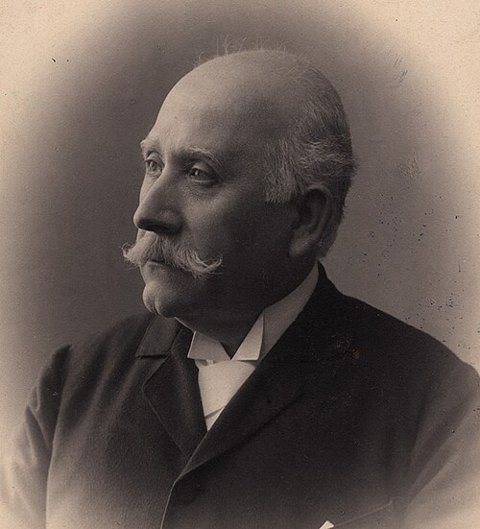
Luigi Capuana (May 28, 1839 – November 29, 1915) was an Italian author and journalist and one of the main exponents of Verismo. He was a contemporary of Giovanni Verga, both having been born in the province of Catania within a year of each other. He was also one of the first Italian authors influenced by the works of Émile Zola, French author and creator of naturalism. His critical theories on naturalism envisaged the ultimate fusion of the novel into a purely scientific, impersonal, case-history.
Early life and education
Luigi Capuana was born in Mineo, in the Province of Catania, the first of eight children. His family was wealthy, and owned property in the area. He attended the local school. In 1851 he enrolled in the Royal College of Bronte, Catania, but left after only 2 years because of bad health. However, he continued to study by teaching himself. Politically, Capuana was far more liberal than his parents, imbued as he was with a patriotism that was genuinely militant.
After graduating he enrolled in the Faculty of Law at Catania in 1857. He abandoned his studies in 1860 in order to take part in the uprising roused by Garibaldi's expedition. He became secretary of the Secret Committee of Insurrection in Mineo, and later chancellor of the nascent civic council.
"Literary Adventures"
In 1861 Capuana released the "dramatic legend" Garibaldi in three cantos, published in Catania by Galatola. In 1864 he settled in Florence, where he spent four productive years, making friends with writers and intellectuals, most notably the poet Aleardo Aleardi, and working as theatre critic for the newspaper La Nazione. It was a rich, valuable apprenticeship, for it afforded him with the opportunity of acquainting himself with several other literatures, particularly the French. In 1867, he published serially in a Florentine daily his first novella, entitled Dr. Cymbalus, which took Dumas fils' La boîte d'argent as a model.