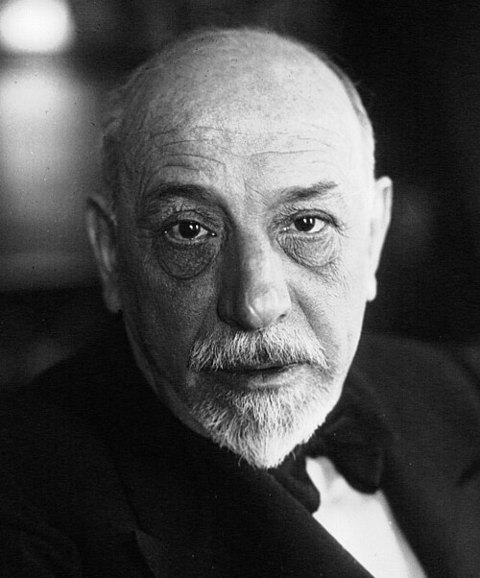
Luigi Pirandello (PIRR-ən-DEL-oh; Italian: [luˈiːdʒi piranˈdɛllo]; 28 June 1867 – 10 December 1936) was an Italian dramatist, novelist, poet, and short story writer most noted for his plays. He was awarded the 1934 Nobel Prize in Literature "for his bold and ingenious revival of dramatic and scenic art". Pirandello's works include novels, hundreds of short stories, and about 40 plays, some of which are written in Sicilian. Pirandello's tragic farces are often seen as forerunners of the Theatre of the Absurd.
Early life
Pirandello was born into an upper-class family in Girgenti (now Agrigento), Sicily, near the poor suburb of Porto Empedocle. His family's surname had originally been the Greek "Pirangelos" (Greek: Πυράγγελος), which had been phonetically corrupted. Pirandello was of Greek descent, as he noted himself in an interview to Kostas Ouranis in 1934.
The area of his birth was called "Caos", from càusi, Sicilian for "trousers", after the shape of a nearby ravine. His father, Stefano Pirandello, belonged to a wealthy family involved in the sulphur industry, and his mother, Caterina Ricci Gramitto, was also of a well-to-do background, descending from a family of the bourgeois professional class of Agrigento. Both families, the Pirandellos and the Ricci Gramittos, were ferociously anti-Bourbon and actively participated in the struggle for unification and democracy (Risorgimento). Stefano participated in the famous Expedition of the Thousand, later following Garibaldi all the way to the battle of Aspromonte, and Caterina, who had hardly reached the age of thirteen, was forced to accompany her father to Malta, where he had been sent into exile by the Bourbon monarchy. But the open participation in the Garibaldian cause and the strong sense of idealism of those early years were quickly transformed, above all in Caterina, into an angry and bitter disappointment with the new reality created by the unification. Pirandello would eventually assimilate this sense of betrayal and resentment and express it in several of his poems and in his novel The Old and the Young. It is also probable that this climate of disillusion inculcated in the young Luigi the sense of disproportion between ideals and reality which is recognizable in his essay on humorism (L'Umorismo).