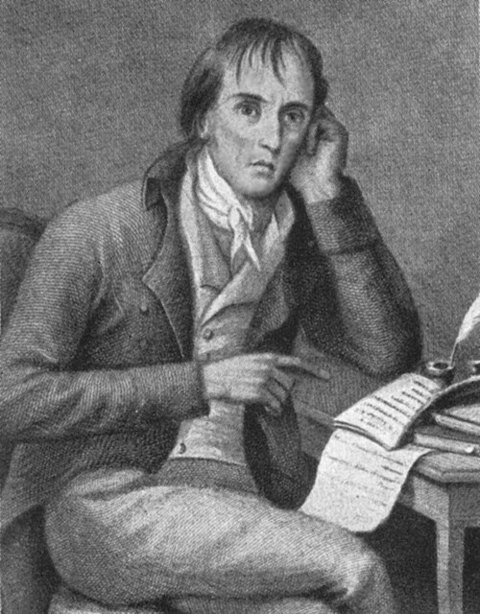
Manuel Maria Barbosa l'Hedois du Bocage (15 September 1765 – 21 December 1805), most often referred to simply as Bocage, was a Portuguese Neoclassic poet, writing at the beginning of his career under the pen name Elmano Sadino.
Biography
Bocage was born in the Portuguese city of Setúbal, in 1765, to José Luís Soares de Barbosa and Mariana Joaquina Xavier l'Hedois Lustoff du Bocage, of French family.
Bocage began to make verses in infancy, and being somewhat of a prodigy grew up to be flattered, self-conscious and unstable. At the age of fourteen, he suddenly left school and joined the 7th Infantry Regiment; but tiring of garrison life at Setúbal after two years, he decided to enter the Portuguese navy. He proceeded to the Royal Marine Academy in Lisbon but instead of studying he pursued romantic adventures. For the next five years he had numerous love affairs, and his retentive memory and extraordinary talent for improvisation gained him a host of admirers and turned his head.
Brazilian modinhas, short rhyming poems sung accompanied by a guitar at family parties, were very popular at the time, and Bocage added to his fame by writing a number of these, by his skill in extemporizing verses on a given theme, and by allegorical idyllic pieces, the subjects of which are similar to those of Watteau's and Boucher's pictures. In 1786 he was appointed guarda-marinha in the Portuguese India navy, and he reached Goa by way of the colony of Brazil in October. There he came into an ignorant society full of petty intrigue, where his particular talents found no scope to display themselves; the glamour of the East left him unmoved and the climate brought on a serious illness. In these circumstances he compared the heroic traditions of Portugal in Asia, which had induced him to leave home, with the reality, and wrote his satirical sonnets on The Decadence of the Portuguese Empire in Asia, and those addressed to Afonso de Albuquerque and D. João de Castro. The irritation caused by these satires, together with rivalries in love affairs, made it advisable for him to leave Goa, and early in 1789 he obtained the post of lieutenant of the infantry company at Damão, India; but he promptly deserted and made his way to Macau, where he arrived in July–August. According to a contemporary tradition, much of "Os Lusíadas" had been written there, and Bocage probably travelled to China following in the footsteps of another classic Portuguese poet, Luís de Camões, to whose life and misfortunes he loved to compare his own. Though he escaped the penalty of his desertion, he had no resources and lived on the charity of friends, whose help enabled him to return to Lisbon in the middle of the following year.