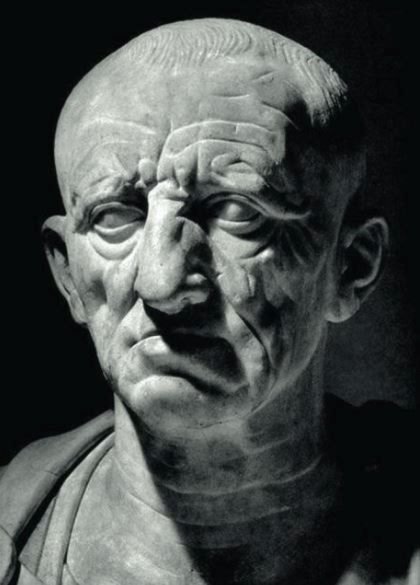
Marcus Porcius Cato (234–149 BC), also known as Cato the Censor (Latin: Censorius), the Elder and the Wise, was a Roman soldier, senator, and historian known for his conservatism and opposition to Hellenization. He was the first to write history in Latin with his Origines, a now fragmentary work on the history of Rome. His work De agri cultura, a treatise on agriculture, rituals, and recipes, is the oldest extant prose written in the Latin language. Cato's epithet "Elder" distinguishes him from his great-grandson Cato the Younger.
Cato came from an ancient plebeian family who were noted for their military service. As a youth, he fought as a military tribune in the Second Punic War with distinction. Like his forefathers, when not serving in the army, Cato was devoted to agriculture. Having attracted the notice of patrician Lucius Valerius Flaccus, he was brought to Rome and began his political career. Cato was successively quaestor (204), aedile (199), praetor (198), and in 195 he was elected consul with Flaccus. As consul, he unsuccessfully opposed the repeal of the Lex Oppia, a law restricting female luxury. His subsequent military campaign and administrative efforts in Hispania proved a major success, and on his return to Rome in 194 BC he was rewarded with a triumph.
Following the end of his consulship, Cato served with distinction as a legate at the Battle of Thermopylae against Seleucid king Antiochus III. In 184 he was elected censor, shortly after his attacks forced Scipio Africanus into retirement. As censor, he introduced taxes on luxuries and oversaw extensive constructions and repairs of public works. Seeking to preserve Rome's ancestral customs, he strongly opposed Hellenistic influences. Later in his life, he also became known for his vigorously anti-Carthaginian stance.