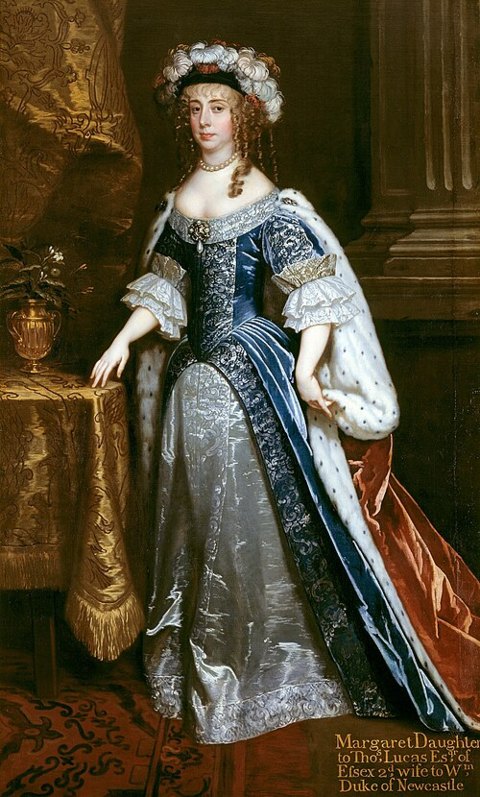
Margaret Cavendish, Duchess of Newcastle-upon-Tyne (née Lucas; 1623 – 16 December 1673) was an English natural philosopher, poet, fiction writer, and playwright. She was a prolific writer, publishing over a dozen original texts under her name at a time when women were largely excluded from publishing.
Although many would credit author Mary Shelley as the inventor of science fiction, Margaret Cavendish can also be counted as an essential pioneer. Her book The Blazing World is one of the first to fall into the science fiction genre. As a well-connected natural philosopher, Cavendish engaged with some of the most influential minds of her time, including René Descartes, Thomas Hobbes, and Henry More.
Background
Born Margaret Lucas to Sir Thomas Lucas (1573–1625) and Elizabeth Leighton (died 1647), she was the youngest child of the family. She had four sisters and three brothers, the royalists Sir John Lucas, Sir Thomas Lucas and Sir Charles Lucas, who owned the manor of St John's Abbey, Colchester. As a teenager, she became an attendant on Queen Henrietta Maria and travelled with her into exile in France, living for a time at the court of the young King Louis XIV. She became the second wife of William Cavendish, 1st Duke of Newcastle-upon-Tyne in 1645.
Her husband, the marquess William Cavendish, 1st Duke of Newcastle, was a Royalist commander in Northern England during the First English Civil War and in 1644 went into voluntary exile in France. Margaret accompanied him and remained abroad until the Stuart Restoration in 1660.