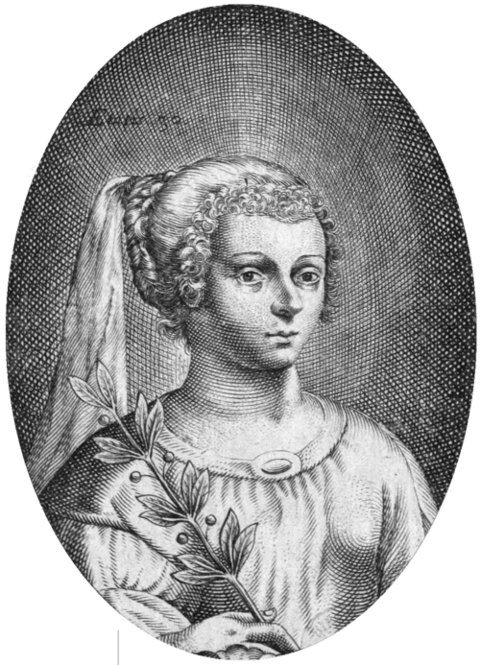
Marie de Gournay (French: [maʁi də ɡuʁnɛ]; 6 October 1565 – 13 July 1645) was a French writer. Author of a novel and a number of other literary compositions, including The Equality of Men and Women (Égalité des hommes et des femmes, 1622) and The Ladies' Grievance (Grief des dames, 1626), she insisted that women should be educated. Gournay was also an editor and commentator of Michel de Montaigne. After Montaigne's death, Gournay edited and published his Essays.
Life
She was born in Paris in 1565. Her father, Guillaume Le Jars, was treasurer to King Henry III of France. In 1568, he obtained feudal rights to the Gournay estate in Picardy, and in 1573, after he purchased the Neufvy estate, he became Seigneur de Neufvy et de Gournay. The family moved to Gournay-sur-Aronde after her father's sudden death in 1577.
Gournay was an autodidact. She studied the humanities and taught herself Latin. Her studies led her to discover the works of Michel de Montaigne. She met him in 1588 in Paris after writing him a note and became his "adopted daughter". She published her first book in 1594, Le Proumenoir de Monsieur de Montaigne.
After her mother's death in 1591, Marie moved to Paris, leaving the family home to her brother Charles, who was forced to sell it in 1608. Montaigne died the following year, and his widow, Françoise de la Chassaigne, provided Gournay with a copy of the Essays and charged her with its publication. In 1595, Gournay published the first posthumous edition of his Essays and in 1598 she published a revised edition. She settled in Paris, determined to earn a living from writing. She published a timely discussion on the education of children in 1608, Bienvenue à Monseigneur le Duc d'Anjou. This work brought her to wider attention among Paris intellectuals. Her 1610 work Adieu de l'ame du Roy de France et de Navarre caused a scandal because it defended Jesuits, who were suspected of having conspired to assassinate King Henry IV. Gournay was attacked in the satirical pamphlet The Anti-Gournay and was pictured as an old shrew.