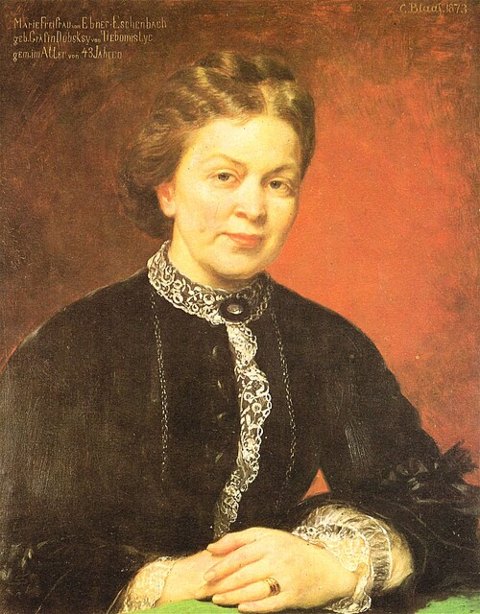
Baroness Marie von Ebner-Eschenbach née Countess Dubsky (Czech: Marie von Ebner-Eschenbachová, German: Marie Freifrau von Ebner-Eschenbach; 13 September 1830 – 12 March 1916) was an Austrian writer and a noblewoman. Noted for her psychological novels, she is regarded as one of the most important German-language writers of the latter portion of the 19th century.
Early life and family
She was born at the castle of the Dubský of Třebomyslice family in Zdislawitz near Kroměříž in Moravia (present Zdislavice in the Czech Republic), the daughter of Baron (from 1843: Count) Franz Joseph Dubský of Třebomyslice, a nobleman whose family roots are deeply Catholic and Bohemian, and his wife Maria Rosalia Therese, née Baroness von Vockel, who came from a noble Protestant-Saxon background.
Marie lost her mother in early infancy, but received a careful intellectual training from two stepmothers, first Baroness Eugenie von Bartenstein, and then her second step-mother, Countess Xaverine von Kolowrat-Krakowsky, who often contributed to her inspiration by taking her to the Burgtheater in Vienna periodically. Despite being part of a noble family, and having access to her family's vast libraries, she was never actually formally schooled. However, because of her curiosity, access to information, and educated family, she became auto-didact at a young age, and was taught fluent French, German, and Czech.
In 1848 she married her cousin, Moritz von Ebner-Eschenbach, a physics and chemistry professor at a Viennese engineering academy. Later on, he would become an Austrian captain, and promoted to lieutenant field marshal on his retirement. The couple resided first in Vienna, then, from 1850, at village Louka (Klosterbruck) near Znojmo (now part of the town), as the engineering academy had been relocated there, and after 1860 again in Vienna. The marriage was childless to disappointment of both of them. Marie grappled with the domestic tasks. She kept a journal and wrote letters explaining how she felt unsatisfied. It has been speculated that Marie may have suffered from "hysteria" including debilitating headaches and excessive nervousness.