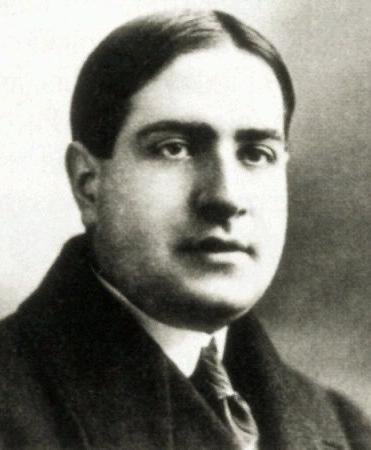
Mário de Sá-Carneiro (pronounced [ˈmaɾju ðɨ ˈsa kɐɾˈnɐjɾu]; May 19, 1890 – April 26, 1916) was a Portuguese poet and writer. He is one of the best known authors of the Geração de Orpheu, and is usually considered their greatest poet, after Fernando Pessoa.
Life
Mário de Sá-Carneiro was born to a wealthy family with a strong military tradition. His mother died in 1892 when he was two years old, and he was subsequently raised by his grandparents. He lived on a farm near Lisbon where he would spend most of his life. Sá-Carneiro started writing poems at the age of 12. By the age of 15, he had already translated several works by Victor Hugo. By 16, he had translated some works of Johann Wolfgang von Goethe and Friedrich Schiller. He began to write fiction in high school, partly due to his work as an actor. In 1911, he left for Coimbra, where he was admitted to law school, although he never progressed beyond his first year. However, he met a man who would soon become his closest friend, Fernando Pessoa, and who introduced him to the group of modernists of Lisbon.
After leaving the city of students, as Coimbra is known, Sá-Carneiro went to Paris to study at the Sorbonne. Although his father continued to pay for his studies, Sá-Carneiro stopped attending classes very soon after arriving in Paris. He lived a bohemian lifestyle, roaming round the theatres and bars.
It was in Paris that he met Guilherme de Santa-Rita (Santa-Rita Pintor), the legendary Portuguese painter.
Orpheu
Together with Fernando Pessoa and Almada Negreiros, he wrote for Orpheu, a literary journal of poetry and artistic prose influenced by cosmopolitanism and the European Avant-Garde. The magazine caused a scandal in Portuguese society because of its futuristic idealism. Only two issues of the magazine were published. A third one was prepared but never published, owing to the controversy surrounding the magazine and a lack of money. Today, Orpheu is known for being one of the finest and most important examples of Portuguese literature, and for introducing modernism in Portugal.