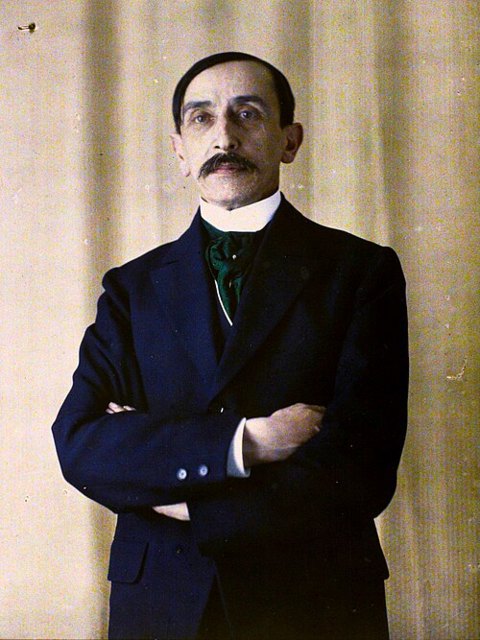
Auguste-Maurice Barrès (French: [oɡyst mɔʁis baʁɛs]; 19 August 1862 – 4 December 1923) was an anti-Semitic French novelist, journalist, philosopher, and politician. Spending some time in Italy, he became a figure in French literature with the release of his work The Cult of the Self in 1888. He was elected a member of the Académie Française in 1906.
In politics, Barrès was first elected to the Chamber of Deputies in 1889 as a Boulangist and would play a prominent political role for the rest of his life. He presided over the Ligue des Patriotes from 1914 until his death in 1923.
Biography
Barrès was associated in his literary works with Symbolism, a movement which had equivalence with British Aestheticism and Italian Decadentism; indeed he was a close associate of Gabriele d'Annunzio representing the latter. As the name of his trilogy suggests, his works glorified a humanistic love of the self and he also flirted with occult mysticisms in his youth. The Dreyfus affair saw an ideological shift from a liberal individualism rooted in the French Revolution to a more organic and traditional concept of the nation. He also became a leading anti-Dreyfusard popularising the term nationalisme to describe his views. He stood on a platform of "Nationalism and Protectionism.".
Politically, he became involved with various groups such as the Ligue des Patriotes of Paul Déroulède, of which he became the leader in 1914. Barrès was close to Charles Maurras, founder of the monarchist party Action Française. Though he remained a republican, Barrès developed a strong influence on various French monarchists of his day, as well as various other figures. During the First World War, he championed the Union Sacrée political truce. In later life, Barrès returned to the Catholic faith: he was involved in a campaign to restore French church buildings and helped establish 24 June as a national day of remembrance for St. Joan of Arc.