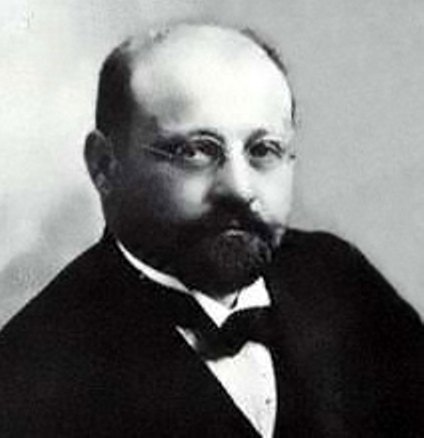
Miksa Déri (27 October 1854 – 3 March 1938) was a Hungarian electrical engineer, inventor, power plant builder. He contributed with his partners Károly Zipernowsky and Ottó Bláthy in the development of the closed iron core transformer and the ZBD model.
Born in Bács, Miksa Déri obtained his diploma in hydraulic engineering in 1877 at the Technical University of Vienna. Between 1878 and 1882 he was engaged in designing of the Duna and Tisza river control systems, and studied electrotechnics. In 1882 he began working at the Ganz factory as an engineer. Later on he became the factory's director.
His other important invention was the constant voltage AC electrical generator in the Ganz Works in 1883. The missing link of a full Voltage sensitive - voltage intensive (VSVI) system was the reliable AC Constant Voltage generator. Therefore, the invention of the constant voltage generator at the Ganz Works played a crucial role in the beginnings of the industrial scale AC power generating, because only these types of generators can produce a stated output voltage, regardless of the value of the actual load.
Déri is also noted for inventing the single phase type of repulsion motor.
Déri died in Merano, Italy in 1938.