Rouva Meseck
Online reading View book
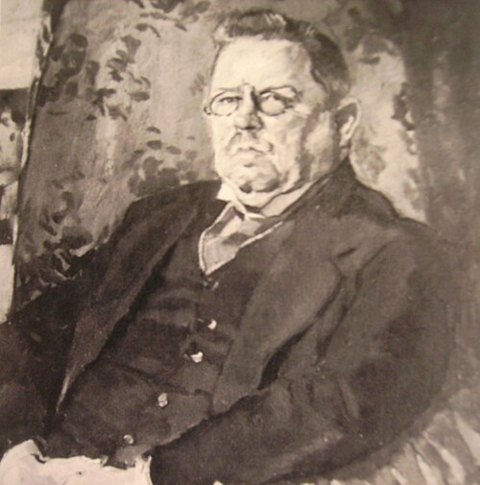
Author
German dramatist (1865-1944)
Max Halbe (4 October 1865 – 30 November 1944) was a German dramatist and main exponent of Naturalism.
Halbe was born at the manor of Güttland (Koźliny) near Danzig (Gdańsk), where he grew up. He was a member of an old family of peasants who had immigrated two centuries earlier from Westphalia. He attended the gymnasium (secondary school) at Marienburg. In 1883, he began his study of law at Heidelberg University. He studied history and Germanic philology at the Friedrich Wilhelm University of Berlin from 1885 to 1887. He obtained his doctorate at the Ludwig-Maximilians-Universität München in 1888.
He then moved to Berlin. In both Berlin and Munich, Halbe became acquainted with the leaders of the new naturalistic movement in German literature, and became associated with the Free Stage (German: Freie Bühne) movement in 1889. He was strongly influenced by the association with, and the works of, Johannes Schlaf and Arno Holt. In the spring of 1890, he wrote the play Free Love (German: Freie Liebe), later called Ein Verhältnis (1895). He married the same year. Halbe was not entirely in accord with the Freie Bühne, and with consistent naturalism (see Gerhart Hauptmann), as the latter deviated considerably from his own tendencies.
He published Eisgang in 1892, and then his primary work, Jugend (Youth), in 1893, which was, after Hauptmann's Die Weber, the most successful contemporary stage play in Germany. It was difficult for him to get Eisgang and Jugend performed, although Jugend got a performance on the Freie Volksbühne in 1892. Jugend was especially difficult to place: famous theatre managers in Berlin (L'Arronge, Barnay, Blumenthal) refused it, but Lautenburg accepted and performed it with great success in 1893. The drama, whose unaffected and sympathetic treatment of sexual relationships made no concessions to prevailing bourgeois morality, won it the enthusiastic praise of socialist critics. Franz Mehring, the principal spokesman of the Social Democratic Party of Germany on culture, warmly welcomed Jugend and referred to Halbe, along with Gerhardt Hauptmann, as "one of the princes of Genius land." In 1917 an operatic version of Jugend, composed by Ignatz Waghalter, was premiered in Berlin at the Deutsches Opernhaus (now known as the Deutsche Oper) to great acclaim.
Text: “Max Halbe”, from Wikipedia, the free encyclopedia, under the license CC BY-SA 4.0. Dates and facts: Wikidata.
Collection
1 book