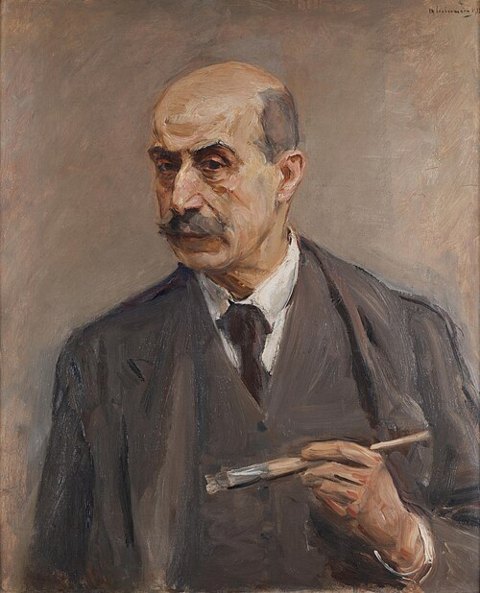
Max Liebermann (20 July 1847 – 8 February 1935) was a German painter and printmaker, and one of the leading proponents of Impressionism in Germany and continental Europe. In addition to his activity as an artist, he also assembled an important collection of French Impressionist works.
The son of a Jewish banker, Liebermann studied art in Weimar, Paris, and the Netherlands. After living and working for some time in Munich, he returned to Berlin in 1884, where he remained for the rest of his life. He later chose scenes of the bourgeoisie, as well as aspects of his garden near Lake Wannsee, as motifs for his paintings. Noted for his portraits, he did more than 200 commissioned ones over the years, including of Albert Einstein and Paul von Hindenburg.
Liebermann was honored on his 50th birthday with a solo exhibition at the Prussian Academy of Arts in Berlin, and the following year he was elected to the academy. From 1899 to 1911 he led the premier avant-garde formation in Germany, the Berlin Secession. Beginning in 1920 he was president of the Prussian Academy of Arts. On his 80th birthday, in 1927, Liebermann was celebrated with a large exhibition, declared an honorary citizen of Berlin and hailed in a cover story in Berlin's leading illustrated magazine. But such public accolades were short-lived. In 1933 he resigned when the academy decided to no longer exhibit works by Jewish artists, before he would have been forced to do so under laws restricting the rights of Jews. His art collection, which his wife inherited after his death, was looted by the Nazis after her death in 1943.
In his various capacities as a leader in the artistic community, Liebermann spoke out often for the separation of art and politics. In the words of arts reporter and critic, Grace Glueck, he "pushed for the right of artists to do their own thing, unconcerned with politics or ideology." His interest in French Realism was offputting to conservatives, for whom such openness suggested what they thought of as Jewish cosmopolitanism.