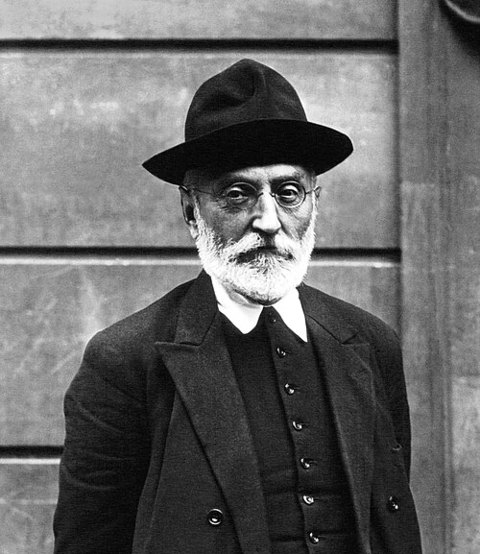
Miguel de Unamuno y Jugo (OO-nə-MOO-noh, Spanish: [miˈɣel de unaˈmuno i ˈxuɣo, wnaˈmuno j -]; 29 September 1864 – 31 December 1936) was a Spanish essayist, novelist, poet, playwright, philosopher and academic. His major philosophical essay was Tragic Sense of Life (1913), and his most famous novels were Abel Sánchez: The History of a Passion (1917), a modern exploration of the Cain and Abel story, and Mist (1914), which The Literary Encyclopedia calls "the most acclaimed Spanish Modernist novel".
Early life and education
Miguel de Unamuno was born in Bilbao, a port city of the Basque Country, Spain, the son of Félix de Unamuno and Salomé Jugo. As a young man, he was interested in the Basque language, which he could speak, and competed for a teaching position in the Instituto de Bilbao against Sabino Arana. The contest was finally won by the Basque scholar Resurrección María de Azkue.
Academic career
Unamuno worked in all major genres: the essay, the novel, poetry, and theater, and, as a modernist, contributed greatly to dissolving the boundaries between genres. There is some debate as to whether Unamuno was in fact a member of the Generation of '98, an ex post facto literary group of Spanish intellectuals and philosophers founded by José Martínez Ruiz (Azorín)—a group that includes, besides Azorín, Antonio Machado, Ramón Pérez de Ayala, Pío Baroja, Ramón del Valle-Inclán, Ramiro de Maeztu, and Ángel Ganivet, among others.
University of Salamanca
Unamuno would have preferred to be a philosophy professor, but was unable to get an academic appointment. Instead, in 1891, he became a Greek professor at University of Salamanca.