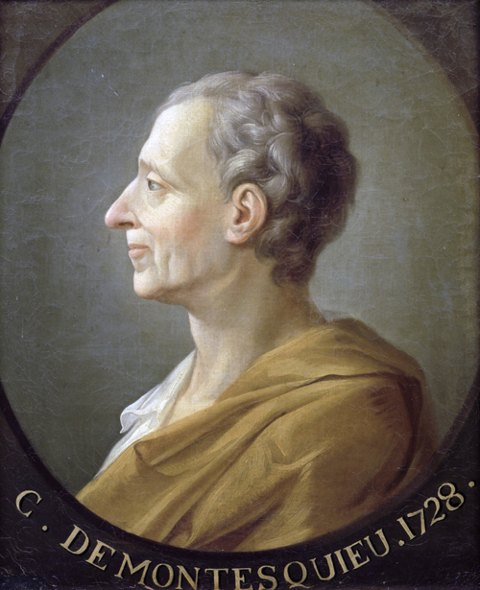
Charles Louis de Secondat, baron de La Brède et de Montesquieu (18 January 1689 – 10 February 1755), generally referred to as simply Montesquieu, was a French jurist, historian, and political philosopher.
He is the principal source of the theory of separation of powers, which is implemented in many constitutions throughout the world. He is also known for propagating the term despotism in the modern political lexicon.
Montesquieu's anonymously published The Spirit of Law (De l'esprit des lois, 1748), first translated into English by Thomas Nugent in a 1750 edition, was received well in both Great Britain and the American colonies, where it influenced the Founding Fathers of the United States in drafting the U.S. Constitution.
Early life and education
Montesquieu was born at the Château de la Brède in southwest France, 25 kilometres (16 mi) south of Bordeaux. His father, Jacques de Secondat (1654–1713), was a soldier with a long noble ancestry, including descent from Richard de la Pole, Yorkist claimant to the English crown. His mother, Marie Françoise de Pesnel (1665–1696), who died when Charles was seven, was an heiress who brought the title of Barony of La Brède to the Secondat family.
His family was of Huguenot origin. After the death of his mother he was sent to the Catholic College of Juilly, a prominent school for the children of French nobility, where he remained from 1700 to 1711. His father died in 1713, and he became a ward of his uncle, the Baron de Montesquieu. In 1714, he became a counselor of the Bordeaux Parlement. He showed a preference for Protestantism.