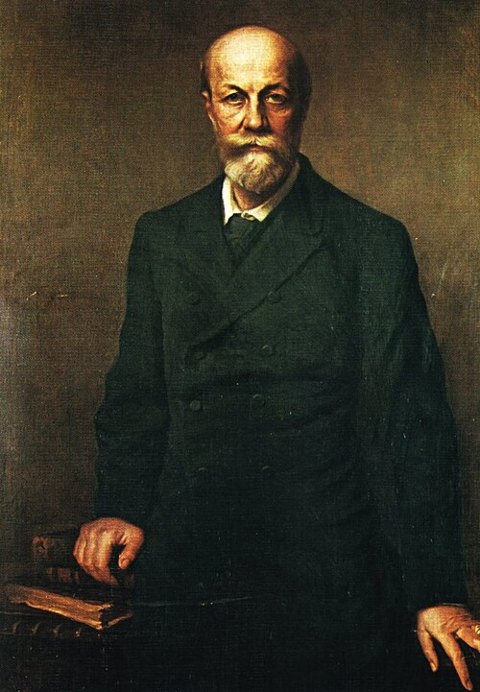
Móricz Jókay of Ásva [ˈmoːr ˈjoːkɒi] (18 February 1825 – 5 May 1904), known as Mór Jókai, was a Hungarian novelist, dramatist and revolutionary. Outside of Hungary, he was also known as Maurice Jókai or Maurus Jókai or Mauritius Jókai. He was a leader of the outbreak of the Hungarian Revolution of 1848 in Pest. His romantic novels became widely popular among the elite of Victorian England, where he was often compared to Charles Dickens by the press. One of his most famous admirers was Queen Victoria herself.
Early life
He was born in Komárom in the Kingdom of Hungary to József Jókai of Ásva (1781–1837), a member of the Ásva branch of the ancient Jókay noble family; his mother was noblewoman Mária Pulay (1790–1856). As a boy, he was timid and his health delicate, so he was educated at home until the age of ten, when he was sent to Pozsony (today Bratislava, Slovakia). He then attended the Calvinist college of Pápa (Pápai Református Kollégium), where he first met Sándor Petőfi and Sándor Kozma.
When Jókai was twelve, his father died. His family wanted him to become a lawyer like his father had been, and he completed his education in Kecskemét and Pest to that end. He won his first case as an independent lawyer.
Career
Jókai was bored by his work as a lawyer, and he was encouraged in his art by the praise the Hungarian Academy of Sciences gave his first play (Hungarian: Zsidó fiú, lit. 'Jewish Boy'). In 1845, he moved to Pest where Petőfi introduced him to literary circles. Within the year his first noted novel (Hungarian: Hétköznapok, lit. 'Working Days') was published as a serial by Pesti Divatlap, followed by a hardcover edition in 1846. It was received with widespread critical acclaim. The following year, Jókai was appointed the editor of Életképek, the then-leading Hungarian literary magazine, and gathered a circle of young writers around himself.