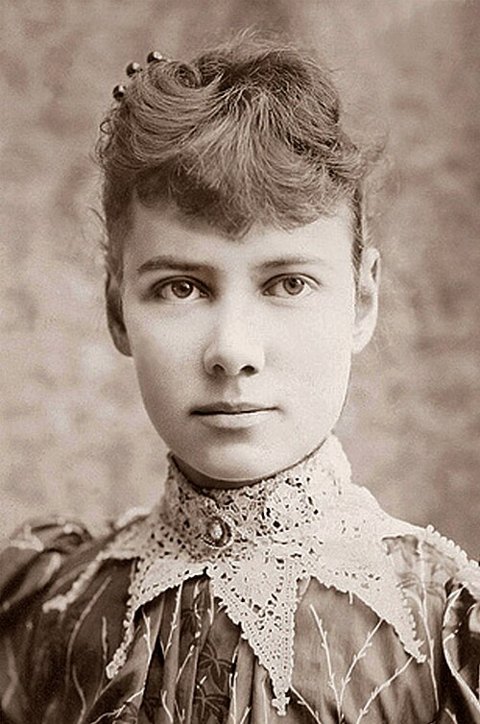
Elizabeth Cochrane Seaman (born Elizabeth Jane Cochran; May 5, 1864 – January 27, 1922), better known by her pen name Nellie Bly, was an American journalist who was widely known for her record-breaking trip around the world in 72 days in emulation of Jules Verne's fictional character Phileas Fogg, and for an exposé in which she worked undercover to report on a mental institution from within. She ushered in the era of stunt girl reporting and helped advance a new kind of immersion journalism.
Early life
Elizabeth Jane Cochran was born May 5, 1864, in Cochran's Mills, now part of Burrell Township, Armstrong County, Pennsylvania. Her father, Michael Cochran, born about 1810, started as a laborer and mill worker before buying the local mill and most of the land surrounding his family farmhouse. He later became a merchant, postmaster, and associate justice at Cochran's Mills (named after him) in Pennsylvania. Cochran married twice. He had 10 children with his first wife, Catherine Murphy, and five more children, including Elizabeth, his thirteenth daughter, with his second wife, Mary Jane Kennedy. He died in 1870, when Elizabeth was 6.
As a young girl, Elizabeth often was called "Pink" because she so frequently wore that color. As a teenager, she wanted to portray herself as more sophisticated, so she dropped the nickname and changed her surname to Cochrane. In 1879, she enrolled at Indiana Normal School (now Indiana University of Pennsylvania) for one term but was forced to drop out due to lack of funds. In 1880, Cochrane's mother moved her family to Allegheny City, which was later annexed by the City of Pittsburgh.