Niccolò Tommaseo (Italian: [nikkoˈlɔ ttommaˈzɛːo]; 9 October 1802 – 1 May 1874) was a Dalmatian Italian linguist, journalist and essayist, the editor of a Dizionario della Lingua Italiana (A Dictionary of the Italian Language) in eight volumes (1861–74), of a dictionary of synonyms (1830) and other works. He is considered a precursor of the Italian irredentism.
Biography
Born at Sebenico (Šibenik), which was in quick succession under Venetian, Napoleonic and Habsburg domain, Tommaseo was culturally and ethnically Italian, but expressed also a genuine interest in the Illyrian popular culture. His education, pursued at Spalato (Split), was a humanistic one with a sound Catholic basis.
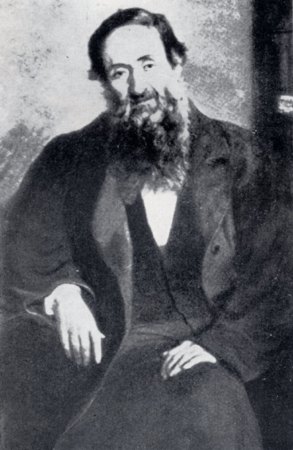
He moved to Italy to graduate in law at the University of Padua in 1822. He then spent several years as a journalist roving between Padua and Milan, where he came in contact with Alessandro Manzoni and Antonio Rosmini-Serbati. In this period of life, he began his collaboration in the Antologia of Giovan Pietro Vieusseux, founder of the Gabinetto Vieusseux, the reading room and intellectual centre in Florence. He also corresponded with Petar II Petrović Njegoš of Montenegro and Medo Pucić. Nikola Tomazeo (Niccolò Tommaseo) is regarded as part of both the Italian and Serbian literary corpus according to critic Jovan Skerlić who included him in his Istorja nove srpske književnosti (1914).
A friend of Antonio Rosmini, of Vincenzo Monti and of Alessandro Manzoni, in 1825 he met in Florence in the Gabinetto Vieusseux Giacomo Leopardi, but their friendship deteriorated after a short time. In the novel Faith and Beauty (Fede e bellezza, 1840) he describes his love relationship in an oscillation between moralism and eroticism which pushed Manzoni to accuse him of being a public Catholic sinner.