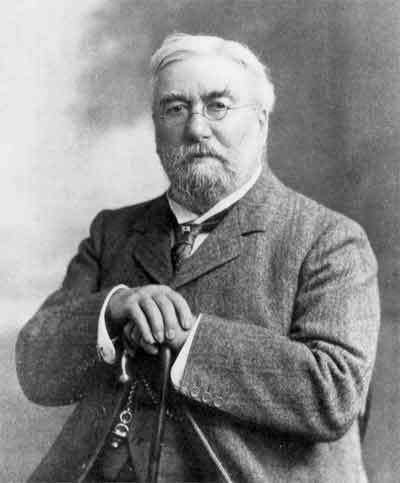
Sir Joseph Norman Lockyer (17 May 1836 – 16 August 1920) was an English scientist and astronomer. Along with the French scientist Pierre Janssen, he is credited with discovering the gas helium. Lockyer also is remembered for being the founder and first editor of the influential journal Nature.
Biography
Lockyer was born in Rugby, Warwickshire. His early introduction to science was through his father, who was a pioneer of the electric telegraph. After a conventional schooling supplemented by travel in Switzerland and France, he worked for some years as a civil servant in the British War Office. He settled in Wimbledon, South London after marrying Winifred James, who helped translate at least four French scientific works into English.
He was a keen amateur astronomer with a particular interest in the Sun. In 1885 he became the world's first professor of astronomical physics at the Royal College of Science, South Kensington, now part of Imperial College. At the college, the Solar Physics Observatory was built for him and here he directed research until 1913.
In the 1860s Lockyer became fascinated by electromagnetic spectroscopy as an analytical tool for determining the composition of heavenly bodies. He conducted his research from his new home in West Hampstead, with a 6+1⁄4-inch telescope which he had already used in Wimbledon.
In 1868 a prominent yellow line was observed in a spectrum taken near the edge of the Sun. Its wavelength was about 588 nm, slightly less than the so-called "D" lines of sodium. The line could not be explained as due to any material known at the time, and so it was suggested by Lockyer, after he had observed it from London, that the yellow line was caused by an unknown solar element. He named this element helium after the Greek word ἥλιος (helios) meaning 'sun'. An observation of the new yellow line had been made earlier by Janssen at the 18 August 1868 solar eclipse