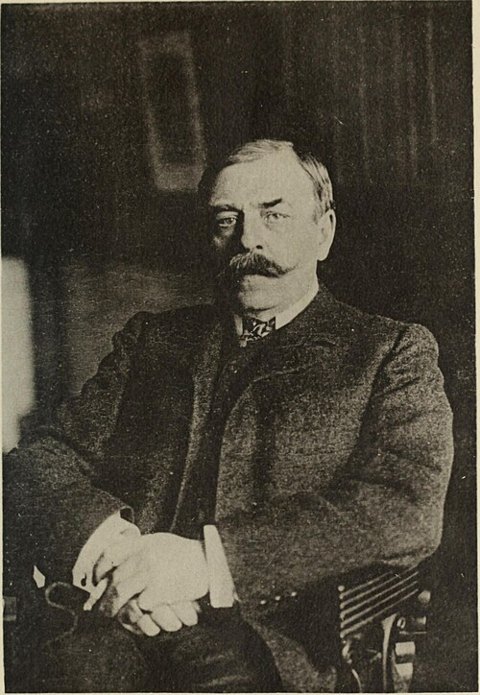
Octave Henri Marie Mirbeau (French: [ɔktav miʁbo]; 16 February 1848 – 16 February 1917) was a French novelist, art critic, travel writer, pamphleteer, journalist and playwright, who achieved celebrity in Europe and great success among the public, whilst still appealing to the literary and artistic avant-garde with highly transgressive novels that explored violence, abuse and psychological detachment. His work has been translated into 30 languages.
Aesthetic and political struggles
The grandson of Norman notaries and the son of a doctor, Mirbeau spent his childhood in a village in Normandy, Rémalard, pursuing secondary studies at a Jesuit college in Vannes, which expelled him at the age of fifteen. Two years after the traumatic experience of the 1870 war, he was tempted by a call from the Bonapartist leader Dugué de la Fauconnerie, who hired him as private secretary and introduced him to L'Ordre de Paris.
After his debut in journalism in the service of the Bonapartists, and his debut in literature when he worked as a ghostwriter, Mirbeau began to publish under his own name. Thereafter, he wrote in order to express his own ethical principles and aesthetic values. A supporter of the anarchist cause (cf. La Grève des électeurs) and fervent supporter of Alfred Dreyfus, Mirbeau embodied the intellectual who involved himself in civic issues. Independent of all parties, Mirbeau believed that one's primary duty was to remain lucid.
As an art critic, he campaigned on behalf of the "great gods nearest to his heart": he sang the praises of Auguste Rodin, Claude Monet, Camille Pissarro, Paul Cézanne, Paul Gauguin, Félicien Rops Auguste Renoir, Félix Vallotton, and Pierre Bonnard, and was an early advocate of Vincent van Gogh, Camille Claudel, Aristide Maillol, and Maurice Utrillo (cf. his Combats esthétiques, 1993).