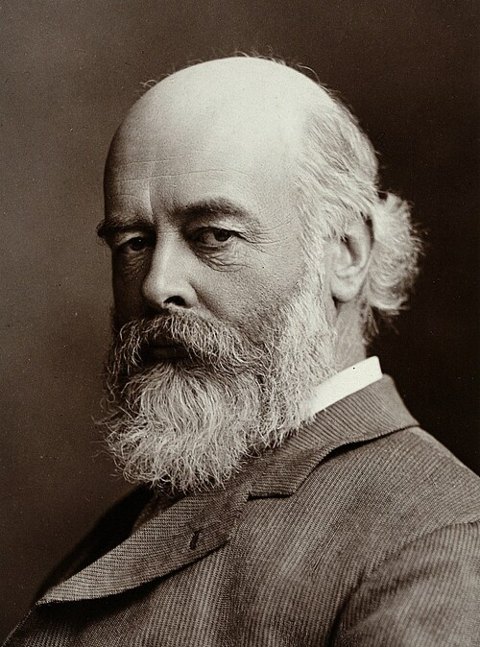
Sir Oliver Joseph Lodge (12 June 1851 – 22 August 1940) was an English physicist and electrical engineer whose investigations into electromagnetic radiation (EMR) contributed to the development of radio. He identified EMR independent of Heinrich Hertz's proof. In his 1894 Royal Institution lecture, The Work of Hertz and Some of His Successors, Lodge's demonstrations on methods to transmit and detect radio waves included an improved early radio receiver he named the coherer. His work led to his holding key patents in early radio communication, his "syntonic" (or tuning) patents.
Lodge became Assistant Professor of Applied Mathematics in Bedford College, London in 1879, was appointed Professor of Physics in University College Liverpool in 1881 and was Principal of the University of Birmingham from 1900 to 1919.
Lodge was a pioneer of spiritualism; his pseudoscientific research into life after death was a topic on which he wrote many books, including the best-selling Raymond; or, Life and Death (1916), which detailed messages he received from a medium, which he believed came from his son who was killed in the First World War.