Author
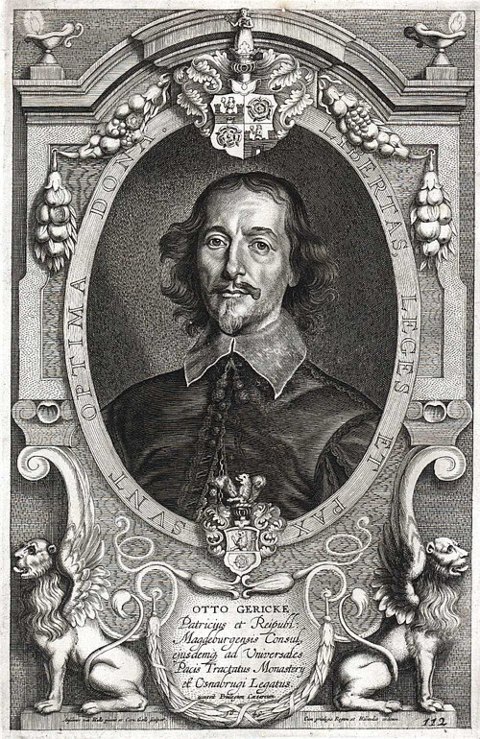
Otto von Guericke
German scientist, inventor, and politician (1602-1686)
- Born
- November 20, 1602, Magdeburg
- Died
- May 11, 1686, Hamburg
- Nationality
- Germany
- Occupation
- Physicist, inventor, politician, jurist and engineer
Life and work
Otto von Guericke (UK: GAIR-ik-ə, US: G(W)AIR-ik-ə, -ee; German: [ˈɔtoː fɔn ˈɡeːʁɪkə]; spelled Gericke until 1666; 30 November [O.S. 20 November] 1602 – 21 May [O.S. 11 May] 1686) was a German scientist, inventor, mathematician, and physicist. His pioneering scientific work, the development of experimental methods and repeatable demonstrations on the physics of the vacuum, atmospheric pressure, electrostatic repulsion, his advocacy for the reality of "action at a distance" and of "absolute space" were noteworthy contributions for the advancement of the Scientific Revolution.
Early life and education
Otto von Guericke was born to a patrician family of Magdeburg. He was privately tutored until the age of fifteen. In 1617 he began studying law and philosophy at the Leipzig University. However, in 1620 his studies were disrupted by his father's death. He briefly returned home before continuing his studies at the Academia Julia in Helmstedt and the universities of Jena and Leiden. It was at Leiden that he first attended courses on mathematics, physics and military engineering. He concluded his academic education with a nine-month Grand Tour to France and England.
Family
Upon his return to Magdeburg in 1626 he married Margarethe Alemann, with whom he had three children (Anna Catherine, Hans Otto, and Jacob Christopher) before her untimely death in 1645. Anna Catherine and Jacob Christopher both died in infancy and in 1652 von Guericke married Dorothea Lentke.
Political career
Von Guericke was the offspring of one of Magdeburg's leading patrician families, that were well-educated and well-connected. His father and grandfather had been life-long members of the city council and at various occasions during their careers been appointed to serve as mayor of the city. In 1626, Otto von Guericke started his career as political representative of Magdeburg and accepted an official appointment to join the city council. However, in 1618, the Thirty Years' War had broken out. This exceptionally long, tragic and destructive conflict would soon also descend upon Magdeburg. Only a few years later, he had luckily fled from the city before an army of the imperial Catholic League, led by the Count of Tilly had completely surrounded and cut off Magdeburg. The attack culminated in the single most devastating event of the entire war, namely the Sack of Magdeburg. In May 1631, the imperial troops had crushed the city walls and indiscriminately plundered the riches. Around eighty percent of its more than 25,000 inhabitants perished. The material loss was also unusually high as widespread fires destroyed about 1,700 of a total of 1,900 buildings, including all of von Guericke's personal property. He returned to Magdeburg in 1631 and his academic engineer education designated him an appointee of the reconstruction committee.
Text: “Otto von Guericke”, from Wikipedia, the free encyclopedia, under the license CC BY-SA 4.0. Dates and facts: Wikidata.
Collection
Books by Otto von Guericke
1 book