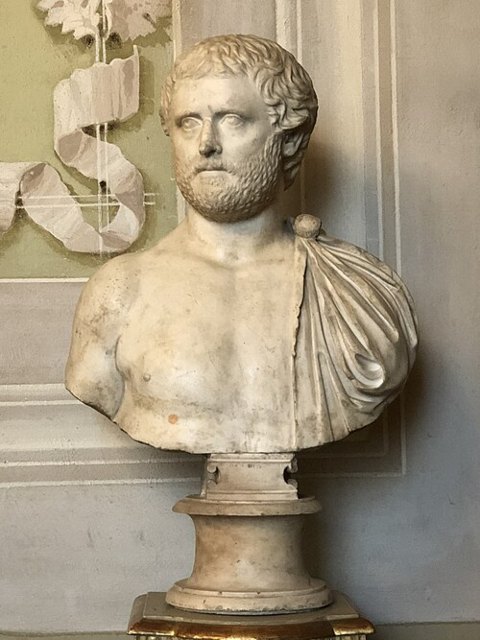
Publius Ovidius Naso (Latin: [ˈpuːbliʊs ɔˈwɪdiʊs ˈnaːsoː]; 20 March 43 BC – AD 17/18), known in English as Ovid (OV-id), was a Roman poet who lived during the reign of Augustus. He was a younger contemporary of Virgil and Horace, with whom he is often ranked as one of the three canonical poets of Latin literature. The Imperial scholar Quintilian considered him to be the last of the Latin love elegists. Although Ovid enjoyed enormous popularity during his lifetime, the emperor Augustus exiled him to Tomis, the capital of the newly organized province of Moesia, on the Black Sea, where he remained for the last nine or 10 years of his life. Ovid himself attributed his banishment to a carmen et error ("poem and a mistake"), but his reluctance to disclose specifics has resulted in much speculation among scholars.
Ovid is most famous for the Metamorphoses, a continuous mythological narrative in fifteen books written in dactylic hexameters. He is also known for works in elegiac couplets such as Ars Amatoria ("The Art of Love") and Fasti. His poetry was much imitated during Late Antiquity and the Middle Ages, and greatly influenced Western art and literature. The Metamorphoses remains one of the most important sources of classical mythology today.