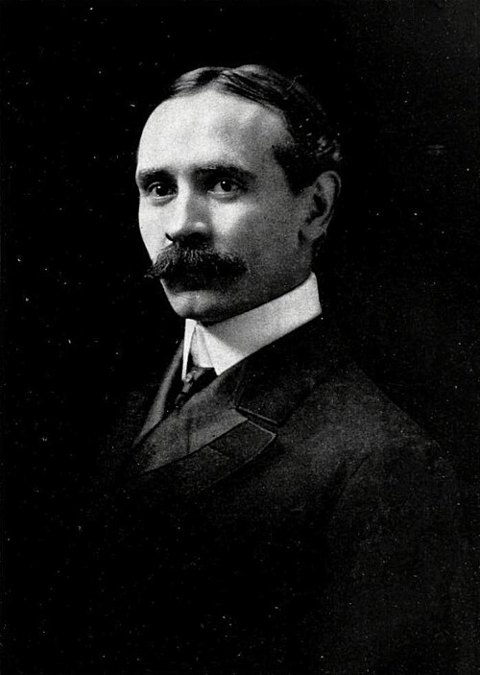
Paul Samuel Reinsch (June 10, 1869 – January 26, 1923), was an American political scientist and diplomat. He played an influential role in developing the field of international relations. He helped form the American Political Science Association and the American Society of International Law.
He was a strong proponent of the Open Door Policy (a system of equal trade and investment and to guarantee the territorial integrity of Qing China) and a critic of imperialism.
Early life
Reinsch was born in Milwaukee, Wisconsin, of German-American parents. He graduated from the University of Wisconsin in 1892, attended the school of law there, and after graduating in 1894, was admitted to the bar and practiced law in Milwaukee for some time.
Academic career
He returned to the University of Wisconsin for additional schooling in 1895, enrolled as a PhD student in history and political science. He earned a Ph.D. in political science under Frederick Jackson Turner in 1898. While Reinsch was at the University of Wisconsin, Richard Ely founded the School of Economics, Political Science and History. Reinsch was a progressive and his fellow student and friend Francis McGovern would go on to become Governor of Wisconsin and implement progressive policies.
He was assistant professor of political science from 1899 to 1901, and full professor from 1901 to 1913. He reportedly established the first course in international politics at the University of Wisconsin in 1899.
In 1900, Reinsch published World Politics at the End of the Nineteenth Century. The book, which focuses on great power disputes over China, German imperialism and American expansionism, has been characterized as an early writing within the field of political science that recognized that international politics were shaped by unique economic, political and intellectual forces. In the book, Reinsch identifies a shift from nationalism to national imperialism where the new desire of European nation-states is to control as much territory as possible.