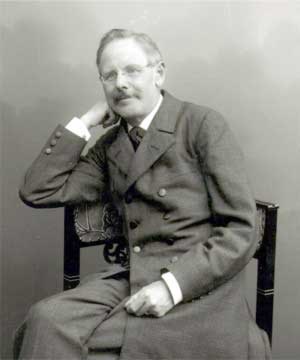
Peter Rosegger (original Roßegger) (31 July 1843 – 26 June 1918) was an Austrian writer and poet from Krieglach in the province of Styria. He was a son of a mountain farmer and grew up in the woodlands and mountains of Alpl. Rosegger (or Rossegger) went on to become a prolific poet and author as well as an insightful teacher and visionary.
In his later years, he was honoured by officials from various Austrian universities and the city of Graz (the capital of Styria). He was nominated for the Nobel Prize in Literature three times. He was nearly awarded the Nobel Prize in 1913 and is (at least among the people of Styria) something like a national treasure to this day.
Early life
Rosegger was born as the first of seven children of a peasant couple in the village of Alpl, in the mountains above Krieglach, Styria. The family lived in a simple 18th-century Alpine farmhouse, called Kluppeneggerhof. Living conditions were modest, the central room was used for eating, sleeping and working. Food was prepared over a hearth in the scullery. The farmhouse is now part of the Universalmuseum Joanneum, but even today the building ensemble can only be reached by foot.
Since this little village, consisting only of a handful of farms, had neither a church nor a school, Rosegger and the other children would have had to walk down the mountain to the larger village, St. Kathrein, in order to attend either. The way there takes two hours and as a result, Peter had very limited education, largely provided by a wandering teacher who taught him and other children from the region for a year and a half. His physical constitution was not sufficient for him to become a farmer like his father, as he was often sick and rather frail in general. So, he became understudy of a traveling tailor at the age of seventeen.