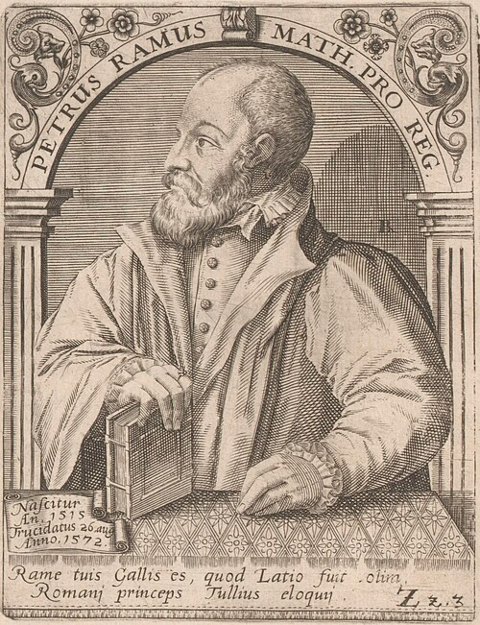
Petrus Ramus (French: Pierre de La Ramée; Anglicized as Peter Ramus; 1515 – 26 August 1572) was a French humanist, logician, and educational reformer. A prominent and controversial academic and professor in Paris' College De France, Ramus became famous for his iconoclastic critiques of Aristotle, Cicero, and Quintilian. Ramus argued that dialectic should be removed or separated from the purview of rhetoric, a stance which significantly narrowed rhetorical theory's scope. A convert to Protestantism, he was a victim of the St. Bartholomew's Day massacre.
Early life
He was born at the village of Cuts, Picardy; his father was a farmer. He gained admission at age twelve (thus about 1527) to the Collège de Navarre, working as a servant. A reaction against scholasticism was in full tide, at a transitional time for Aristotelianism. On the occasion of receiving his M.A. degree in 1536, Ramus allegedly took as his thesis Quaecumque ab Aristotele dicta essent, commentitia esse (Everything that Aristotle has said is false), which Walter J. Ong paraphrases as follows:
All the things that Aristotle has said are inconsistent because they are poorly systematized and can be called to mind only by the use of arbitrary mnemonic devices.
According to Ong this kind of spectacular thesis was in fact routine at the time. Even so, Ong raises questions as to whether Ramus actually ever delivered this thesis.
Early academic career
Ramus, as graduate of the university, started courses of lectures. At this period he was engaged in numerous separate controversies. One opponent in 1543 was the Benedictine Joachim Périon. He was accused, by Jacques Charpentier, professor of medicine, of undermining the foundations of philosophy and religion. Arnaud d'Ossat, a pupil and friend of Ramus, defended him against Charpentier. Ramus was made to debate Goveanus (Antonio de Gouveia), over two days. The matter was brought before the parlement of Paris, and finally before Francis I. By him it was referred to a commission of five, who found Ramus guilty of having "acted rashly, arrogantly and impudently," and interdicted his lectures (1544).