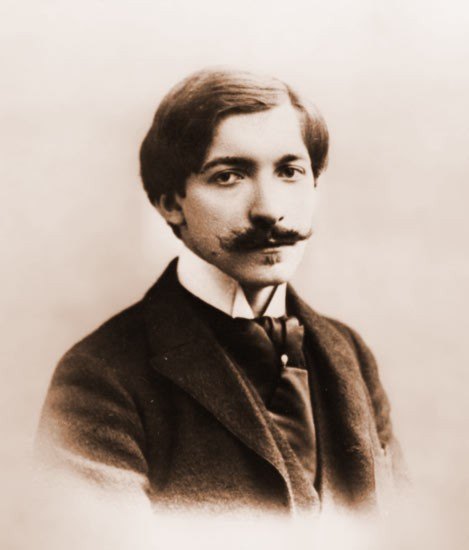
Pierre-Félix Louÿs (French: [pjɛʁ lu.is]; 10 December 1870 – 4 June 1925) was a Belgian poet and writer, most renowned for lesbian and classical themes in some of his writings. He is known as a writer who sought to "express pagan sensuality with stylistic perfection". He was made first a Chevalier and then an Officer of the Légion d'honneur for his contributions to French literature.
Life
Pierre Louÿs was born Pierre Félix Louis on 10 December 1870 in Ghent, Belgium, but relocated to France, where he spent the rest of his life. He studied at the École Alsacienne in Paris, and there he developed a good friendship with a future Nobel Prize winner and champion of homosexual rights André Gide. From 1890 onwards, he began spelling his name as "Louÿs", and pronouncing the final S, as a way of expressing his fondness for classical Greek culture (the letter Y is known in French as i grec or "Greek I"). During the 1890s, he became a friend of the Irish homosexual dramatist Oscar Wilde, and was the dedicatee of Wilde's Salomé in its original (French) edition. Louÿs started writing his first erotic texts at the age of 18, at which time he developed an interest in the Parnassian and Symbolist schools of writing. Louÿs had a long-term romantic relationship with
fellow writer Marie de Régnier.
Early writings
During 1891, Louÿs helped initiate a literary review, La Conque, where he proceeded to publish Astarte, an early collection of erotic verse already marked by his distinctive style. During 1894 he published another erotic collection of 143 prose poems, Songs of Bilitis (Les Chansons de Bilitis), this time with strong lesbian themes. It was divided into three sections, each representative of a phase of Bilitis's life: Bucolics in Pamphylia, Elegies at Mytilene, and Epigrams in the Isle of Cyprus; dedicated to her were also a short Life of Bilitis and three epitaphs in The Tomb of Bilitis. What made The Songs sensational is Louÿs's claim that the poems were the work of an ancient Greek courtesan and contemporary of Sappho, Bilitis; to himself, Louÿs ascribed the modest role of translator. The pretense did not last long, and "translator" Louÿs was soon revealed as Bilitis herself. This did little to discredit The Songs of Bilitis, however, as it was praised for its sensuality and refined style, even more extraordinary for the author's compassionate portrayal of lesbian sexuality.