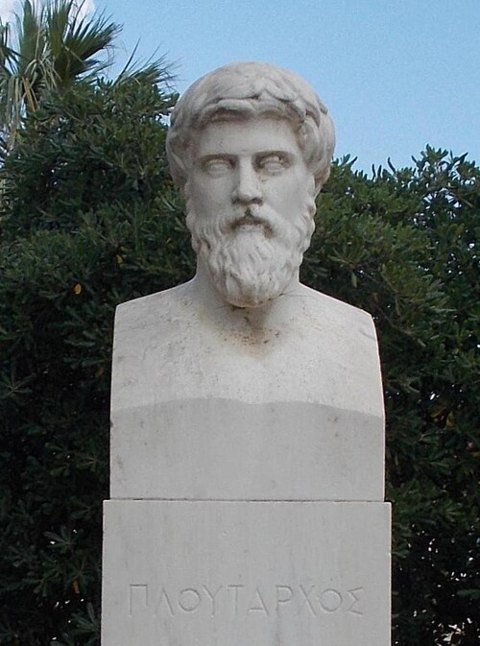
Plutarch (Ancient Greek: Πλούταρχος, Ploútarchos, Koine Greek: [ˈplúːtarkʰos]; before CE 50 – after 120) was a Greek and later Roman Middle Platonist philosopher, historian, biographer, essayist, and priest at the Temple of Apollo in Delphi. He is known primarily for his Parallel Lives, a series of biographies of illustrious Greeks and Romans, and Moralia, a collection of essays and speeches. Upon becoming a Roman citizen, he was possibly named Lucius Mestrius Plutarchus (Λούκιος Μέστριος Πλούταρχος).
Family
Plutarch was born to a prominent family in the small town of Chaeronea, about 30 kilometres (19 mi) east of Delphi, in the Greek region of Boeotia. His family was long established in the town; his father was named Autobulus and his grandfather was named Lamprias. His brothers, Timon and Lamprias, are frequently mentioned in his essays and dialogues, which speak of Timon in particular in the most affectionate terms.
Studies and life
Plutarch studied mathematics and philosophy in Athens under Ammonius from AD 66 to 67. He attended the games of Delphi where the emperor Nero competed and possibly met prominent Romans, including future emperor Vespasian. At some point, Plutarch received Roman citizenship. His sponsor was Lucius Mestrius Florus, who was an associate of the new emperor Vespasian, as evidenced by his new name, Lucius Mestrius Plutarchus. As a Roman citizen, Plutarch would have been of the equestrian order. He visited Rome some time c. AD 70 with Florus, who served also as a historical source for his Life of Otho. Plutarch was on familiar terms with a number of Roman nobles, particularly the consulars Quintus Sosius Senecio, Titus Avidius Quietus, and Arulenus Rusticus, all of whom appear in his works.