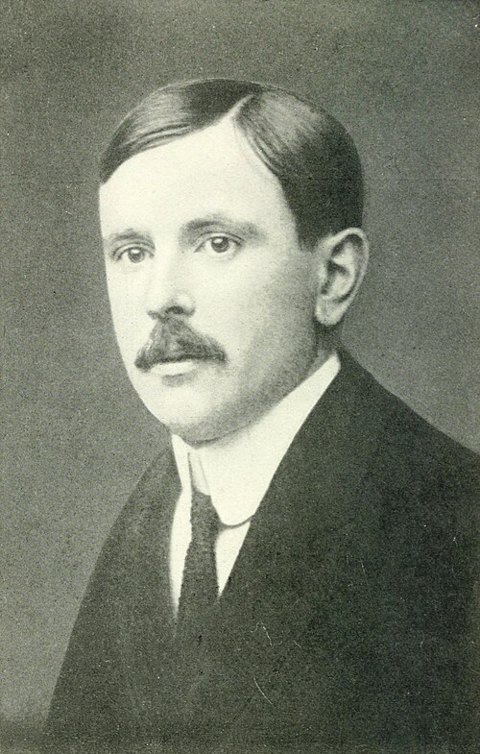
Robert William Seton-Watson (20 August 1879, in London – 25 July 1951, in Skye), commonly referred to as R. W. Seton-Watson and also known by the pseudonym Scotus Viator, was a British political activist and historian who played an active role in encouraging the breakup of Austria-Hungary and the emergence of Czechoslovakia and Yugoslavia during and after the First World War.
He was the father of two eminent historians, Hugh, who specialised in 19th-century Russian history, and Christopher, who worked on 19th-century Italy.
Early life
Seton-Watson was born in London to Scottish parents. His father, William Livingstone Watson, had been a tea-merchant in Calcutta, and his mother, Elizabeth Lindsay Seton, was the daughter of George Seton, a genealogist and historian and the son of George Seton of the East India Company.
He was educated at Winchester College and New College, Oxford, where he read modern history under the historian and politician Herbert Fisher. He graduated with a first-class degree in 1901.
In Austria-Hungary
After graduation, Seton-Watson travelled to Berlin University, the Sorbonne and Vienna University from where he wrote a number of articles on Hungary for The Spectator. His research for these articles took him to Hungary in 1906, and his discoveries there turned his sympathies against Hungary and in favour of the subjected Slovaks, Romanians and Southern Slavs. He learned Hungarian, Serbian and Czech, and in 1908 published his first major work, Racial Problems in Hungary.
Seton-Watson became friends with the Vienna correspondent of The Times, Henry Wickham Steed, and the Czechoslovak philosopher and politician Tomáš Masaryk. He argued in books and articles for a federal solution to the problems of Austria-Hungary, then driven by the tensions between its ancient dynastic model and the forces of ethnic nationalism.