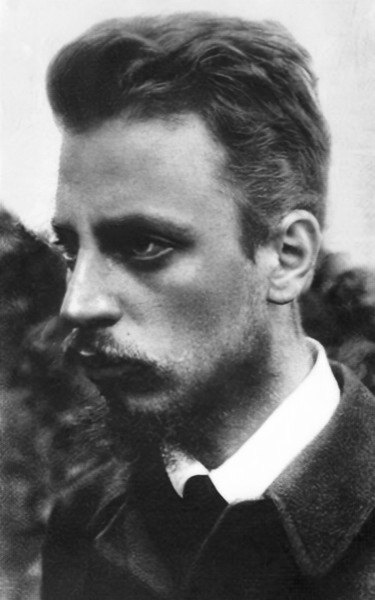
René Karl Wilhelm Johann Josef Maria Rilke (4 December 1875 – 29 December 1926), known as Rainer Maria Rilke, was an Austrian poet. Acclaimed as an idiosyncratic and expressive poet, he is widely recognized as a significant writer in the German language. His work is viewed by critics and scholars as possessing undertones of mysticism, exploring themes of subjective experience and disbelief. His writings include one novel, several collections of poetry, several volumes of correspondence and a few early novellas.
Rilke travelled extensively throughout Europe, finally settling in Switzerland, which provided the inspiration for many of his poems. While Rilke is best known for his contributions to German literature, he also wrote in French. Among English-language readers, his best-known works include two poetry collections: Duino Elegies (Duineser Elegien) and Sonnets to Orpheus (Die Sonette an Orpheus), a semi-autobiographical novel The Notebooks of Malte Laurids Brigge (Die Aufzeichnungen des Malte Laurids Brigge). A collection of ten letters was published posthumously as Letters to a Young Poet (Briefe an einen jungen Dichter).
In the later 20th century, his work found new audiences in citations by self-help authors and frequent quotations in television shows, books and motion pictures.