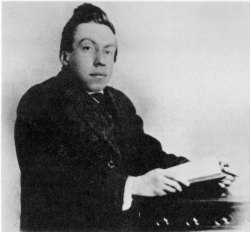
Randolph Silliman Bourne (May 30, 1886 – December 22, 1918) was a progressive writer and intellectual born in Bloomfield, New Jersey, and a graduate of Columbia University. He is considered to be a spokesman for the young radicals living during World War I. His articles appeared in journals including The Seven Arts and The New Republic. Bourne is best known for his essays, especially his unfinished The State, which was discovered after he died and published posthumously in the 1919 collection Untimely Papers. It includes his famous dictum war is essentially the health of the state, which laments the success of governments in arrogating authority and resources during conflicts.
Early life
Vaughan (1997) observed: "Born on May 30, 1886, in Bloomfield, New Jersey, to a family of solid bourgeois credentials, he was the first son of Sarah Barrett and Charles Rogers Bourne. Vaughan (1997) documented: "His mother's lineage was 'relentlessly aristocratic,'.... His father's ancestors came from upstate New York, of predominantly Protestant clergymen and teachers." Bourne's face was deformed at birth by misused forceps and the umbilical cord was coiled round his left ear, leaving it permanently damaged and misshapen. At the age of four, he suffered tuberculosis of the spine, which resulted in his stunted growth and a hunched back. He chronicled his experiences in his essay titled, The Handicapped - by one of them, which is considered a foundational work in disability studies.
Clayton (1988) described Bourne's father as a "mediocre salesman" and that "his business failures grew common." Abrahams (1986) observed that Bourne's mother "was a religious woman and a member of the local Presbyterian Church" and that "she headed the household, which also included another son, Donald, and two younger daughters, Natalie and Ruth." Two different accounts exist about the failure of the marriage. Abrahams (1986) described Bourne's mother as a "wilful woman [who] forced her husband to leave home for good when his business failed and he began to drink heavily." In contrast, Clayton (1988) recounted "Charles's drinking was worse, and the Barretts issued a command: Charles must go. Uncle Halsey would support them." Sherman (1966) similarly recounted that the brother-in-law of Bourne's father agreed to support the family on condition that he left home.