Locus Solus
Online reading View book
Author
French poet, novelist, playwright, musician, and chess enthusiast (1877-1933)
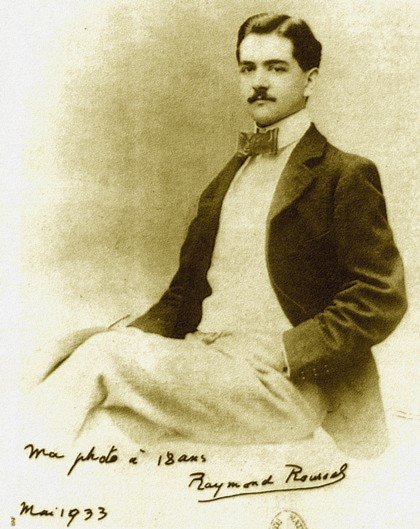
Raymond Roussel (French: [ʁɛmɔ̃ ʁusɛl]; 20 January 1877 – 14 July 1933) was a French poet, novelist, playwright, musician, and chess enthusiast. Through his novels, poems, and plays he exerted a profound influence on certain groups within 20th century French literature, including the Surrealists, Oulipo, and the authors of the nouveau roman.
Roussel was born in Paris, the third and last child in his family, with a brother named Georges and a sister named Germaine. In 1893, at age 15, he was admitted to the Paris Conservatoire for piano. A year later, he inherited a substantial fortune from his deceased father and began to write poetry to accompany his musical compositions. At age 17, he wrote Mon Âme, a long poem published three years later in Le Gaulois. By 1896, he had commenced editing his long poem La Doublure when he suffered a mental crisis. After the poem was published on 10 June 1897 and was completely unsuccessful, Roussel began to see the psychiatrist Pierre Janet. In subsequent years, his inherited fortune allowed him to publish his own works and mount luxurious productions of his plays. He wrote and published some of his most important work between 1900 and 1914, and then from 1920 to 1921 traveled around the world. He continued to write for the next decade, but when his fortune finally gave out, he made his way to a hotel in Palermo, where he died of a barbiturate overdose in 1933, aged 56. He is buried in Père-Lachaise cemetery in Paris.
Roussel's most famous works are New Impressions of Africa and Locus Solus, both written according to formal constraints based on homonymic puns. Roussel kept this compositional method a secret until the publication of his posthumous text, How I Wrote Certain of My Books, where he describes it as follows: "I chose two similar words. For example billard (billiard) and pillard (looter). Then I added to it words similar but taken in two different directions, and I obtained two almost identical sentences thus. The two sentences found, it was a question of writing a tale which can start with the first and finish by the second. Amplifying the process then, I sought new words reporting itself to the word billiards, always to take them in a different direction than that which was presented first of all, and that provided me each time a creation moreover. The process evolved/moved and I was led to take an unspecified sentence, of which I drew from the images by dislocating it, a little as if it had been a question of extracting some from the drawings of rebus." For example, Les lettres du blanc sur les bandes du vieux billard/The white letters on the cushions of the old billiard table… must somehow reach the phrase, …les lettres du blanc sur les bandes du vieux pillard/letters [written by] a white man about the hordes of the old plunderer. Although Roussel does state in his posthumous book How I Wrote Certain of My Novels that "It goes without saying that this method was nowhere employed in my other works La Doublure, La Vue and Nouvelles Impressions d'Afrique"; and here could be added the two plays L'étoile au front and La Poussière de soleil.
Text: “Raymond Roussel”, from Wikipedia, the free encyclopedia, under the license CC BY-SA 4.0. Dates and facts: Wikidata.
Collection
1 book