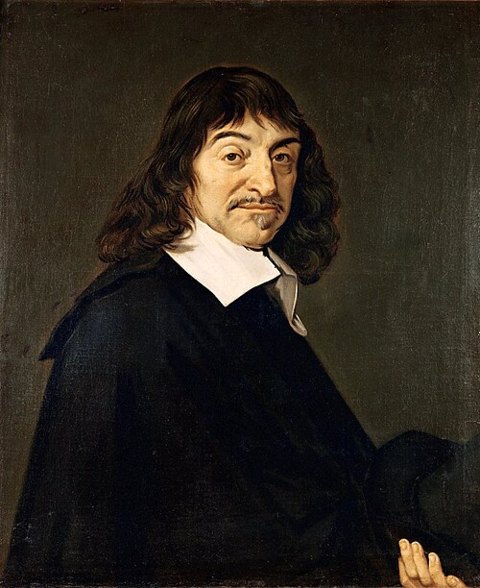
René Descartes (day-KART, also DAY-kart; French: [ʁəne dekaʁt]; 31 March 1596 – 11 February 1650) was a French philosopher, mathematician, and scientist whose work was foundational to mathematics and modern philosophy. He connected the previously separate fields of geometry and algebra into analytic geometry and introduced a systematic method of inquiry that became influential in early modern philosophy. He made major contributions to epistemology and philosophy of mind as well as metaphysics, and influenced the development of modern science.
Refusing to accept the authority of previous philosophers, Descartes frequently set his views apart from the philosophers who preceded him. In the opening section of the Passions of the Soul, an early modern treatise on emotions, Descartes goes so far as to assert that he will write on this topic "as if no one had written on these matters before". His best-known philosophical statement is "cogito, ergo sum" ("I think, therefore I am"; French: "Je pense, donc je suis").
He was one of the key figures in the Scientific Revolution, and his Meditations on First Philosophy and other philosophical works continue to be studied. His influence in mathematics is equally apparent: the Cartesian coordinate system is named after him. Descartes is also credited as the father of analytic geometry, which facilitated the discovery of infinitesimal calculus and analysis.