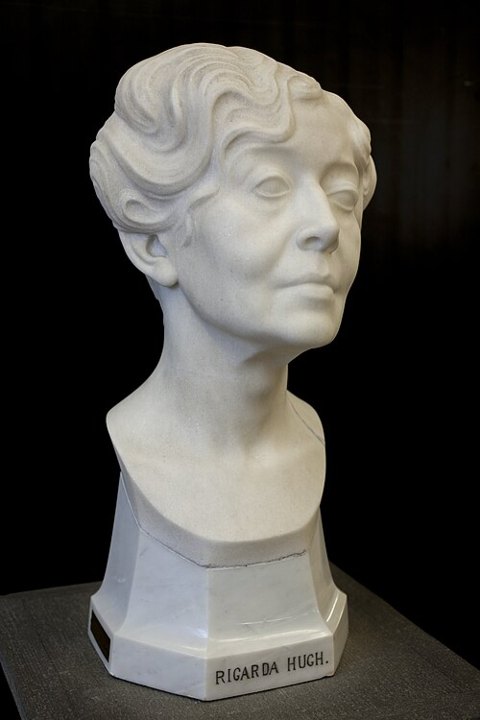
Ricarda Huch (German: [huχ]; 18 July 1864 – 17 November 1947) was a pioneering German intellectual. Trained as a historian, and the author of many works of European history, she also wrote novels, poems, and a play. Asteroid 879 Ricarda is named in her honour.
Early life and education
Huch was born in Braunschweig to Richard Huch (1830–1887) and Emilie, born Hähn (1842–1883), in 1864. The Huchs were a well off merchant family. Her brother Rudolf and cousins Friedrich and Felix were writers. While living with her family in Braunschweig, she corresponded with Ferdinand Tönnies.
Because German universities did not allow women to graduate, Huch left Braunschweig in 1887 and moved to Zurich to take the entrance examinations for the University of Zurich. She matriculated into a PhD program in history and received her doctorate in 1892 for a dissertation on "The neutrality of the Confederation during the Spanish War of Succession" (Die Neutralität der Eidgenossenschaft während des spanischen Erbfolgekrieges). While at the University of Zurich, she established lasting friendships with Marie Baum, Hedwig Bleuler-Waser and Marianne Plehn, who like her had come to Zurich to study.
After receiving her doctorate she found employment at the Zurich public library. In 1896 she taught at a girls' school in Bremen.
Early publications and historic studies
In the 1890s Huch published her first poems and stories. In 1892 her first novel was published Erinnerungen von Ludolf Ursleu dem Jüngeren. In 1897 Huch moved to Vienna to research Romanticism. In Vienna she met the Italian dentist Ermanno Ceconi, whom she married in 1898. In 1899 she gave birth to their daughter Marietta.