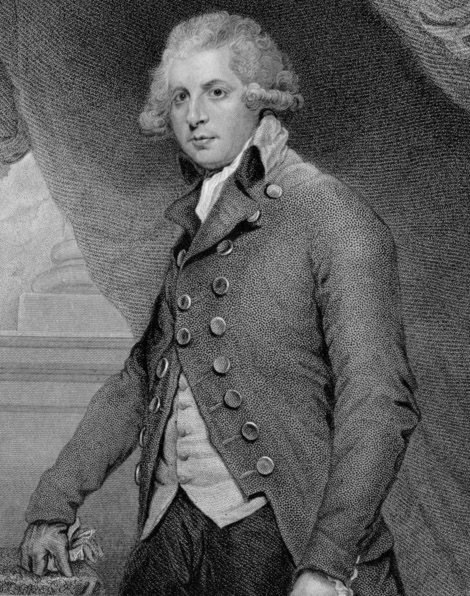
Richard Brinsley Butler Sheridan (30 October 1751 – 7 July 1816) was an Anglo-Irish playwright, writer and Whig politician who sat in the British House of Commons from 1780 to 1812, representing the constituencies of Stafford, Westminster and Ilchester. The owner of the Theatre Royal, Drury Lane, in London, he wrote several prominent plays such as The Rivals (1775), The Duenna (1775), The School for Scandal (1777) and A Trip to Scarborough (1777). He served as Treasurer of the Navy from 1806 to 1807. Sheridan died in 1816 and was buried at Poets' Corner in Westminster Abbey. His plays remain a central part of the Western canon and are frequently performed around the world.
Early life
Sheridan was born in 1751 in Dublin, Ireland, where his family had a house on the then fashionable Dorset Street. His mother, Frances Sheridan, was an Anglo-Irish playwright and novelist. She had two plays produced in London in the early 1760s, though she is best known for her novel The Memoirs of Miss Sidney Biddulph (1761). His Irish father, Thomas Sheridan, was for a while an actor-manager at the Smock Alley Theatre in Dublin, but following his move to England in 1758, he gave up acting and wrote several books on the subject of education, especially the standardisation of the English language in education. His elder brother was Charles Francis Sheridan. His paternal grandfather was The Rev. Thomas Sheridan from County Cavan, who was a close friend of Jonathan Swift.
While his family was in Dublin, Richard attended the English Grammar School in Grafton Street. In 1758, when he was seven years old, the Sheridans moved permanently to England. He was a pupil at Harrow School from 1762 to 1768. At the end of his 1768 school year, his father employed a private tutor, Lewis Ker, to direct his studies in his father's house in London, while Domenico Angelo instructed him in fencing and horsemanship.