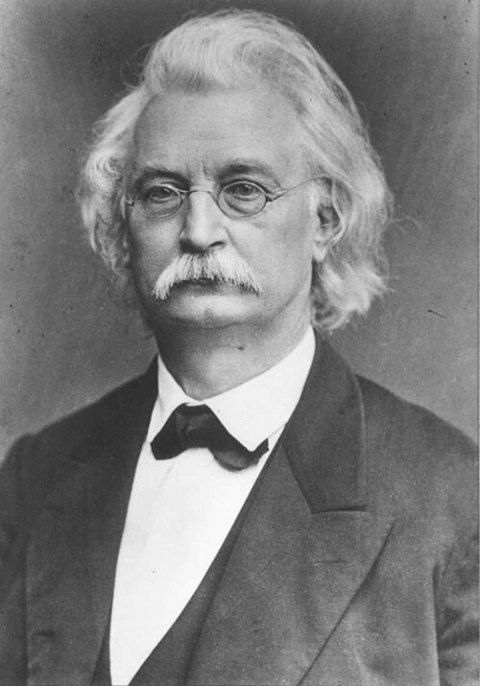
Author
Richard Lepsius
German archaeologist, egyptologist and librarian (1810-1884)
- Born
- December 23, 1810, Naumburg
- Died
- July 10, 1884, Berlin
- Nationality
- German Reich
- Occupation
- Anthropologist, linguist, librarian, archaeologist and Egyptologist
- Notable works
- Denkmäler aus Ägypten und Äthiopien
Life and work
Karl Richard Lepsius (Latin: Carolus Richardius Lepsius; 23 December 1810 – 10 July 1884) was a German Egyptologist, linguist and modern archaeologist.
He is widely known for his opus magnum Denkmäler aus Ägypten und Äthiopien (Monuments from Egypt and Ethiopia), one of the first scientific studies of the pyramids in Giza, Abusir, Saqqara, and Dahshur. His contributions to Egyptology as director of the German Archaeological Instititute and editor of the Zeitschrift für ägyptische Sprache und Altertumskunde have had a lasting impact on the field.
Early life
Karl Richard Lepsius was the son of Carl Peter Lepsius, a classical scholar from Naumburg, and his wife Friederike (née Gläser), who was the daughter of composer Carl Ludwig Traugott Gläser. The family name was originally "Leps" and had been Latinized to "Lepsius" by Karl's paternal great-grandfather Peter Christoph Lepsius. He was born in Naumburg on the Saale, Saxony.
He studied Greek and Roman archaeology at the University of Leipzig (1829–1830), the University of Göttingen (1830–1832), and the Frederick William University of Berlin (1832–1833). After receiving his doctorate following his dissertation De tabulis Eugubinis in 1833, he travelled to Paris, where he attended lectures by the French classicist Jean Letronne, an early disciple of Jean-François Champollion and his work on the decipherment of the Egyptian language, visited Egyptian collections all over Europe and studied lithography and engraving.
Work
After the death of Champollion, Lepsius made a systematic study of the French scholar's Grammaire égyptienne, which had been published posthumously in 1836 but had yet to be widely accepted. In that year, Lepsius travelled to Tuscany to meet with Ippolito Rosellini, who had led a joint expedition to Egypt with Champollion in 1828–1829. In a series of letters to Rosellini, Lepsius expanded on Champollion's explanation of the use of phonetic signs in hieroglyphic writing, emphasizing (contra Champollion) that vowels were not written.
Text: “Karl Richard Lepsius”, from Wikipedia, the free encyclopedia, under the license CC BY-SA 4.0. Dates and facts: Wikidata.
Collection
Books by Richard Lepsius
1 book