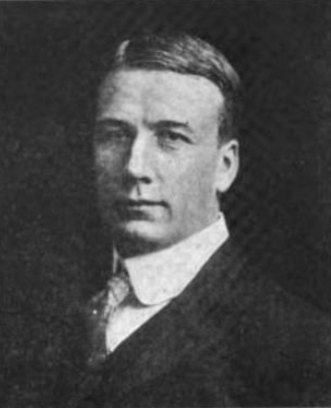
Robert Elliott Speer (September 10, 1867 – November 23, 1947) was an American Presbyterian religious leader and an authority on missions.
Biography
He was born at Huntingdon, Pennsylvania on September 10, 1867. He graduated from Phillips Academy in 1886 and from Princeton in 1889, and studied at Princeton Theological Seminary in 1890–1891.
He became active as an itinerant recruiter for the Student Volunteer Movement (SVM) from 1889 to 1890.
In 1891, he was appointed secretary of the American Presbyterian Mission. He visited missions in Persia, India, China, Korea, and Japan in 1896–1897, and in South America in 1909 and later made similar tours. In Princeton he was greatly influenced by Arthur Tappan Pierson. Under his leadership, the foreign missions of the Presbyterian church became remarkably successful. Speer was specifically noted as being "obsessed" with Persia. He retired in 1937.
He married Emma Doll Bailey in 1893 and, together, they had five children, one of whom, Elliot Speer (1898–1934), became headmaster of Northfield Mount Hermon School, where he was murdered in his home on campus, on September 14, 1934. Their daughter Margaret Bailey Speer (1900–1997) was dean of Yenching Women's College in China in the 1930s, and headmistress of the Shipley School from 1944 to 1965.
He died on November 3, 1947, in Lower Merion Township, Pennsylvania.
Theology
Although he published two articles in The Fundamentals, some have called him liberal because he sided with the Presbyterian Church (USA) and opposed John Gresham Machen during the anti-liberal/modernist controversies of the 1930s. Speer affirmed traditional Christian doctrines such as the historical accuracy of the Bible, the Virgin Birth, and the Resurrection of Christ, yet also embraced a social vision of Christianity which placed him closer to theological liberals than some conservatives would tolerate. He is quoted to have said that Karl Barth offered "an essential recovery of aspects of truth which will not so easily be lost again."