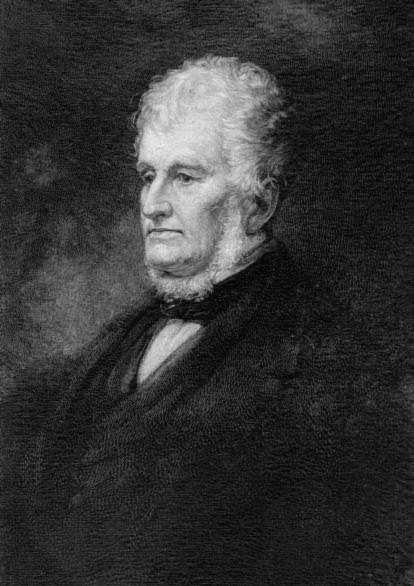
Robert Hare (January 17, 1781 – May 15, 1858) was an early American chemist and professor.
Biography
Hare was born in Philadelphia, Pennsylvania, on January 17, 1781. He developed and experimented with the oxy-hydrogen blowpipe, with Edward Daniel Clarke of Oxford, shortly after 1800. He married Harriett Clark and had six children. In 1802, Hare was elected a member of the American Philosophical Society. He was a professor at the University of Pennsylvania between 1810 and 1812 and between 1818 and 1847. By the 1820s, Hare had developed the "galvanic deflagrator", a type of voltaic battery having large plates used for producing rapid and powerful combustion. He was elected an Associate Fellow of the American Academy of Arts and Sciences in 1824.
Hare died in Philadelphia on May 15, 1858.
Spiritualism
In 1853, Hare conducted experiments with mediums. A year later Hare had converted to Spiritualism and wrote several books that made him very famous in the United States as a Spiritualist. He published a book entitled Experimental Investigation of the Spirit Manifestations (1855). His work was criticized by scientists but was welcomed with enthusiasm by Spiritualists.
One of his experiments utilized a board and spring balance, the other involved the movement of a table at which a medium sat caused a pointer to indicate letters on a wheel. According to the psychical researcher Frank Podmore it would have been easy for the medium to move the table with their knees or other parts of the body but "Hare does not seem to have realized the possibility of fraud of this kind." Podmore also wrote that "the machinery, indeed, was not ill-devised, but its use did not dispense with the necessity for close and continuous observation of the human agent; and there is no evidence that Hare recognized this necessity, or took any steps to guard against trickery."