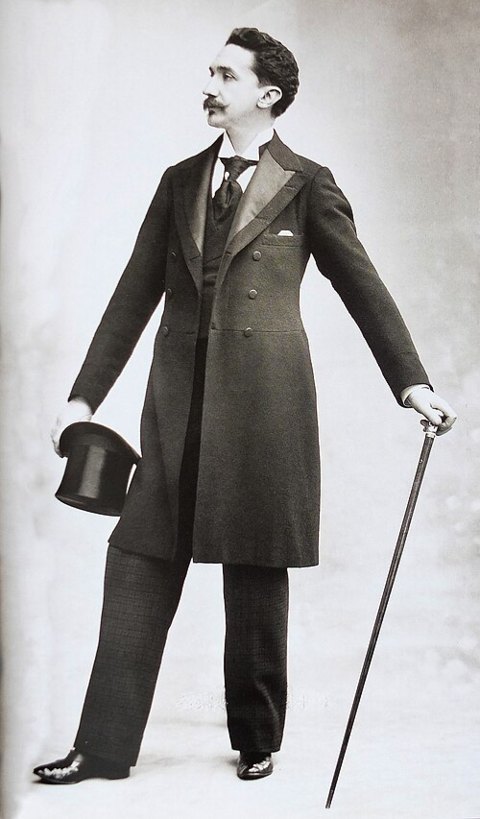
Marie Joseph Robert Anatole, comte de Montesquiou-Fézensac (19 March 1855, Paris – 11 December 1921, Menton) was a French aesthete, Symbolist poet, painter, art collector, art interpreter, and dandy. He is reputed to have been the inspiration both for Jean des Esseintes in Joris-Karl Huysmans' À rebours (1884) and, most famously, for the Baron de Charlus in Marcel Proust's À la recherche du temps perdu (1913–1927). In his play Chantecler, Edmond Rostand is said to have caricatured Montesquiou as the Peacock, 'Prince of the unexpected adjective.'" Some believe that he may have been an inspiration for the character Lord Henry in the 1890 novel The Picture of Dorian Gray by Oscar Wilde.
Family
Robert de Montesquiou was a scion of the French Montesquiou-Fézensac family. His paternal grandfather was Count Anatole de Montesquiou-Fézensac (1788–1878), aide-de-camp to Napoleon and grand officer of the Légion d'honneur; his father was Anatole's third son, Thierry, who married Pauline Duroux, an orphan, in 1841. With his wife's dowry, Thierry bought a country house at Charnizay, built a mansion in Paris, and was elected vice-president of the Jockey Club. He was a successful stockbroker who left a substantial fortune. Robert was the last of his parents' children, after brothers Gontran and Aymery, and sister Élise. His cousin, Élisabeth, Countess Greffulhe (1860–1952), was one of Marcel Proust's models for the Duchess of Guermantes in À la recherche du temps perdu.
Depictions
Montesquiou had the ambition to be the most photographed person in the world.