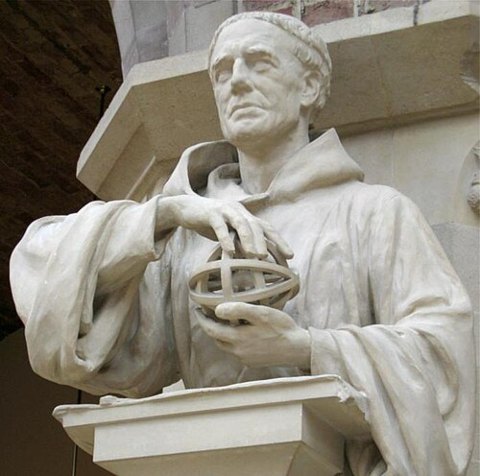
Roger Bacon (Latin: Rogerus or Rogerius Baconus, Baconis, also Frater Rogerus; c. 1219/20 – c. 1292), also known by the scholastic accolade Doctor Mirabilis, was a medieval English polymath, philosopher, scientist, theologian and Franciscan friar who placed considerable emphasis on the study of nature through empiricism. Intertwining his Catholic faith with scientific thinking, Roger Bacon is considered one of the greatest polymaths of the medieval period.
In the early modern era, he was regarded as a wizard and particularly famed for the story of his mechanical or necromantic brazen head. He is credited as one of the earliest European advocates of the modern scientific method, along with his teacher Robert Grosseteste. Bacon applied the empirical method of Ibn al-Haytham (Alhazen) to observations in texts attributed to Aristotle. Bacon discovered the importance of empirical testing when the results he obtained were different from those that would have been predicted by Aristotle.
21st-century re-evaluations emphasise that Bacon was essentially a medieval thinker, with much of his "experimental" knowledge obtained from books in the scholastic tradition. He was, however, partially responsible for a revision of the medieval university curriculum, which saw the addition of optics to the traditional quadrivium.
Bacon's major work, the Opus Majus, was sent to Pope Clement IV in Rome in 1267 upon the pope's request. Although gunpowder was first invented and described in China, Bacon was the first in Europe to record its formula. His linguistic work has been heralded for its early exposition of a universal grammar.