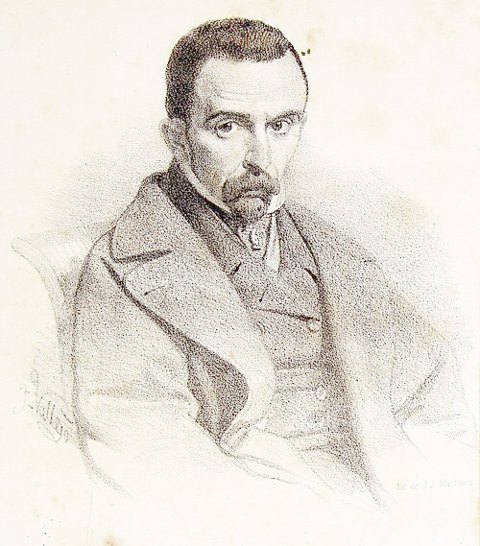
Roque Barcia Martí (Isla Cristina 4 October 1821–Madrid 2 July 1885) was a Spanish writer and republican politician belonging first to the Democratic Party and then, during the Sexenio Democrático (the Spanish Glorious Revolutionary period of 1868–1874), to the Republican Federal Party. He served as a deputy in the Cortes in 1869, 1871, and 1873, as a senator in 1872, and was a leading figure in the Cantón de Cartagena uprising.
Early life
He was born on 4 October 1821. He was the fourth child and second son of the Galician Roque Barcia Ferraces de la Cueva, an official in the tax and customs administration and a scrivener with progressive social ideas, an hidalgo with a family home in the hamlet of Piñeiro in San Miguel de Cora (A Estrada, Pontevedra), and his second wife Teresa Martí Duboy, daughter of the mayor of the nearby town of Redondela, where the family owned property.
During his childhood, he lived in the sandy area of Isla Cristina, frequented by fishermen, and in the town of La Redondela (currently part of Isla Cristina) in the Province of Huelva. Reading the works of Nicolò Donato had made Roque's father a liberal at a very young age, unlike Roque's older paternal uncle, the physician Juan Ramón Barcia Ferraces de la Cueva, a fierce defender of Throne and Altar who eventually became a Carlist. By contrast, ideas of the social pact, general will, and the human being as a free, autonomous individual with rights were always familiar to Roque's father. Consequently, during the Trienio Constitucional (1820–1823), he was a member of the patriotic society known as the Confederación de Caballeros Comuneros, and, when it split in 1823, he joined the group of moderate dissenters who formed the Asamblea constituyente de Comuneros Españoles Constitucionales in Madrid. With the restoration of absolutism by Ferdinand VII, anti-liberal persecution began that same year, forcing him briefly into exile in Portugal; he resumed his patriotic activities publicly from 1834 onward, after the death of the king and thus the end of the Ominous Decade, shortly before his own death in 1838. He had published several essays of what would later be called a kind of “early regenerationism” on the fishing and salt industries.