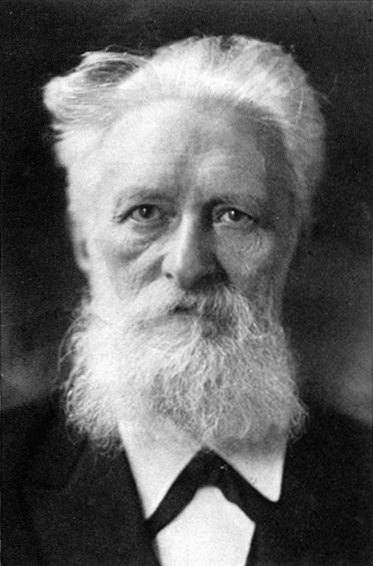
Rudolf Christoph Eucken (German: [ˈʁuːdɔlf ˈɔʏkn̩]; 5 January 1846 – 15 September 1926) was a German philosopher. He received the 1908 Nobel Prize in Literature "in recognition of his earnest search for truth, his penetrating power of thought, his wide range of vision, and the warmth and strength in presentation with which in his numerous works he has vindicated and developed an idealistic philosophy of life", after he had been nominated by a member of the Swedish Academy.
Early life
Eucken was born on 5 January 1846 in Aurich, then in the Kingdom of Hanover (now Lower Saxony). His father, Ammo Becker Eucken died when he was a child, and he was brought up by his mother, Ida Maria (née Gittermann). He was educated at Aurich, where one of his teachers was the classical philologist and philosopher Ludwig Wilhelm Maximilian Reuter. He studied at Göttingen University (1863–1866), where Hermann Lotze was one of his teachers, and Berlin University. In the latter place, Friedrich Adolf Trendelenburg was a professor whose ethical tendencies and historical treatment of philosophy greatly attracted him.
Career
Eucken received his PhD in classical philology and ancient history from Göttingen University in 1866 with a dissertation titled De Aristotelis dicendi ratione. However, the inclination of his mind was definitely towards the philosophical side of theology. In 1871, after five years working as a school teacher at Husum, Berlin und Frankfurt, he was appointed Professor of Philosophy at the University of Basel, Switzerland, succeeding another of his former teachers at Göttingen, Gustav Teichmüller, and beating Friedrich Nietzsche in competition for the position. He stayed there until 1874 when he took up a similar position at the University of Jena. He stayed there until he retired in 1920. In 1912–13, Eucken spent half of the year as an exchange professor at Harvard University, and in 1913 he served as a Deem lecturer at New York University. During World War I, Eucken, like many of his academic colleagues, took a strong line in favor of the causes with which his country had associated itself. The Great War destroyed what had been an international community of scholars.