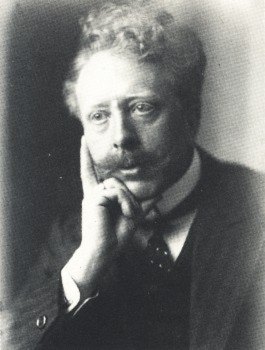
Rudolf Herzog (German: [ˈʁudɔlf ˈhɛɐˌtsoːk]; 6 December 1869 – 3 February 1943) was a German writer and journalist. He was highly popular as a novelist among the German middle class in the period before World War II, expressing Wilhelmian ideals and portraying artists and industrial families. He eventually supported the Nazi Party and fell into obscurity after the war.
Life
Rudolf Herzog was born in Barmen on 6 December 1869. He participated in artists' circles in Düsseldorf, was trained as a colour technician in Elberfeld and attended philosophy lectures in Berlin and Frankfurt before he was able to pursue a career as a writer and journalist. He became cultural editor for Schwarz-Rot in 1894, editor-in-chief at the Hamburger Neueste Nachrichten in 1897 and was head of the culture section of the Berliner Neueste Nachrichten from 1899 to 1903. During this period he began to be published as an author. He participated in World War I in non-combat roles.
Herzog had some success as a poet and playwright, but primarily became known as a novelist. In the period before World War II, he was highly read among the German middle class, reaching a total circulation of around seven million sold books. His best known works include the novels Sons of the Rhine (German: Die Wiskottens) from 1905 and Die Stoltenkamps und ihre Frauen from 1917.
According to the Neue Deutsche Biographie, Herzog's works reflect the ideals of Wilhelmian Germany. His earliest works are post-Romanticist and typically portray artists. The later works portray industrial families and men of action, celebrating hard work, strength, national duties, patriarchal views of social responsibility, and tolerance in religious and erotic issues. The Neue Deutsche Biographie writes that these books are reminiscent of Wilhelm II in their language, by blending "sentimentality and harshness, pomp and plainness", and places them "in the no man's land between trivial literature and poetry".