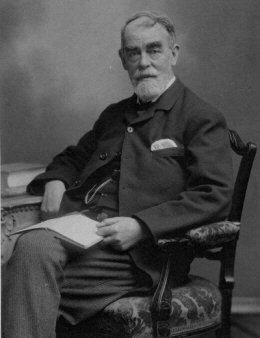
Samuel Butler (4 December 1835 – 18 June 1902) was an English novelist and critic, best known for the satirical utopian novel Erewhon (1872) and the semi-autobiographical novel The Way of All Flesh (published posthumously in 1903 with substantial revisions and published in its original form in 1964 as Ernest Pontifex or The Way of All Flesh). Both novels have remained in print since their initial publication. In other studies he examined Christian orthodoxy, evolutionary thought, and Italian art, and made prose translations of the Iliad and Odyssey that are still consulted.
Early life
Butler was born on 4 December 1835 at the rectory in the village of Langar, Nottinghamshire. His father was Rev. Thomas Butler, son of Dr. Samuel Butler, then headmaster of Shrewsbury School and later Bishop of Lichfield. Dr. Butler was the son of a tradesman and descended from a line of yeomen; despite his family's social class, his scholarly aptitude was recognised at a young age, and he was sent to Rugby and Cambridge, where he distinguished himself.
His only son, Thomas, wished to go into the Navy but succumbed to paternal pressure and entered the Anglican clergy, in which he led an undistinguished career, in contrast to his father's. Samuel's immediate family created for him an oppressive home environment (chronicled in The Way of All Flesh). Thomas Butler, states Samuel Butler's biographer, "to make up for having been a servile son... became a bullying father".
Samuel Butler's relations with his parents, especially with his father, were largely antagonistic. His education began at home and included frequent beatings, as was not uncommon at the time. Samuel wrote later that his parents were "brutal and stupid by nature". He later recorded that his father "never liked me, nor I him; from my earliest recollections I can call to mind no time when I did not fear him and dislike him... I have never passed a day without thinking of him many times over as the man who was sure to be against me." Under his parents' influence, he was set on course to follow his father into the priesthood.