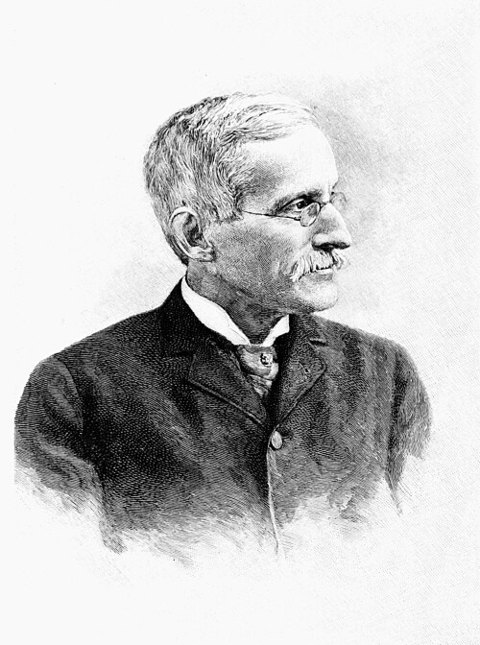
Samuel William Johnson (July 3, 1830 – July 21, 1909) was an American agricultural chemist. He promoted the movement to bring the sciences to the aid of American farmers through agricultural experiment stations and education in agricultural science.
Johnson, working in the 19th century, covered various aspects of farming that today would be called both organic and nonorganic. His work included exposing frauds in artificial manures (some of which would today be called chemical fertilizers).
Biography
Johnson was born in Kingsboro, New York, the son of Abner Adolphus Johnson and Annah Wells Gilbert. Johnson's first teacher was his father; later he studied with David Mayhew in a school at Lowville, New York. Early on he obtained a textbook on chemistry by Fresenius, in which he learned methods of analytical chemistry.
Gaining admission to Yale University, Johnson took lessons from John Pitkin Norton, Benjamin Silliman, Benjamin Silliman, Jr. and James Dwight Dana among others. Upon graduation he went to Leipzig, studying with Otto Linne Erdmann. The next year he went to Munich and Liebig's lab. He studied physiological chemistry with Max Joseph von Pettenkofer and Wolfgang Franz von Kobell. Returning through England, he visited the lab of Edward Frankland and the experimental farms of John Bennet Lawes and Joseph Henry Gilbert.
In 1855 Johnson had his translation of Liebig's The Relations of Chemistry to Agriculture and the Experiments of Mr. J. B. Laws published by Luther Tucker, editor of The Country Gentleman.