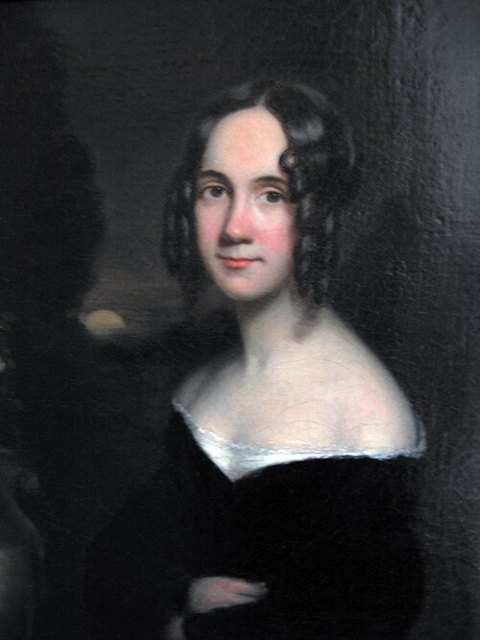
Sarah Josepha Buell Hale (October 24, 1788 – April 30, 1879) was an American writer, activist, and editor of the most widely circulated magazine in the period before the Civil War, Godey's Lady's Book. She was the author of the nursery rhyme "Mary Had a Little Lamb". Hale famously campaigned for the creation of the American Thanksgiving holiday and for the completion of the Bunker Hill Monument.
Early life and family
Sarah Josepha Buell was born in Newport, New Hampshire on October 24, 1788, to Captain Gordon Buell, a Revolutionary War veteran, and Martha Whittlesay Buell. Her parents believed in equal education for girls. Home-schooled by her mother and elder brother Horatio (who had attended Dartmouth), Hale was otherwise an autodidact.
As Sarah Buell grew up and became a local schoolteacher, in 1811 her father opened a tavern called The Rising Sun in Newport. Sarah met lawyer David Hale the same year. The couple married at The Rising Sun on October 23, 1813, and ultimately had five children: David (1815), Horatio (1817), Frances (1819), Sarah (1820) and William (1822). David Hale died in 1822, and Sarah Josepha Hale wore black for the rest of her life as a sign of perpetual mourning.
Career
In 1823, with the financial support of her late husband's Freemason lodge, Sarah Hale published a collection of her poems titled The Genius of Oblivion. The Masonic movement continued their support throughout her career.
Four years later, in 1827, her first novel was published in the U.S. under the title Northwood: Life North and South and in London under the title A New England Tale. The novel made Hale one of the first novelists to write a book about slavery, as well as one of the first American woman novelists. The book also espoused New England virtues as the model to follow for national prosperity, and was an immediate success. The novel supported relocating the nation's African slaves to freedom in Liberia. In her introduction to the second edition (1852), Hale wrote: "The great error of those who would sever the Union rather than see a slave within its borders, is, that they forget the master is their brother, as well as the servant; and that the spirit which seeks to do good to all and evil to none is the only true Christian philanthropy." The book described how while slavery hurts and dehumanizes slaves absolutely, it also dehumanizes the masters and slows their world's psychological, moral and technological progress.