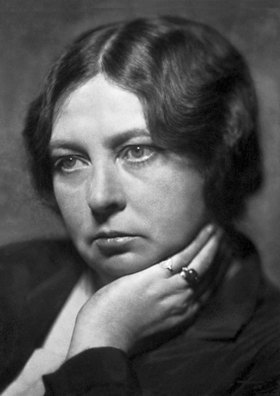
Sigrid Undset (Norwegian pronunciation: [ˈsɪ̂ɡːɾiː ˈʉ̂nːseːt]; 20 May 1882 – 10 June 1949) was a Danish-born Norwegian novelist. She was awarded the 1928 Nobel Prize in Literature.
Born in Denmark and raised in Norway, Undset had her first books of historical fiction published in 1907. She fled Norway for the United States in 1940 because of her opposition to Nazi Germany and the German invasion and occupation of Norway, but returned after the end of World War II in Europe in 1945.
Her best-known work is Kristin Lavransdatter, a trilogy about life in Norway in the Middle Ages, portrayed through the experiences of a woman from birth until death. Its three volumes were published between 1920 and 1922.
Early life
Sigrid Undset was born on 20 May 1882 in the small town of Kalundborg, Denmark, at the childhood home of her mother, Charlotte Undset (1855–1939, née Anna Maria Charlotte Gyth). Her father was the Norwegian archaeologist Ingvald Martin Undset (1853–1893). Sigrid Undset was the eldest of three daughters. She and her family moved to Norway when she was two.
She grew up in the Norwegian capital, Oslo (or Kristiania, as it was known until 1925), where the family moved in July 1884. When she was only 11 years old, her father died at the age of 40 after a long illness.
The family's economic situation meant that Undset had to give up hope of a university education and after a one-year secretarial course she obtained work at the age of 16 as a secretary with an engineering company in Kristiania, a post she went on to hold for 10 years. She later said that she detested the work.