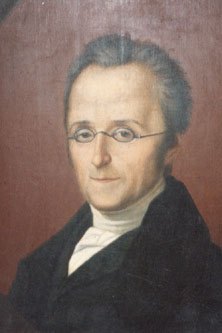
Silvio Pellico (Italian: [ˈsilvjo ˈpɛlliko]; 24 June 1789 – 31 January 1854) was an Italian writer, poet, dramatist and patriot active in the Italian unification. His legacy is mainly linked to his memoirs My Prisons.
Biography
Silvio Pellico was born in Saluzzo, Piedmont. He spent the earlier portion of his life at Pinerolo and Turin, under the tuition of a priest named Manavella. At the age of ten, he composed a tragedy inspired by a translation of the Ossianic poems. On the marriage of his twin sister Rosina with a maternal cousin at Lyon, he went to reside in that city, devoting himself for four years to the study of French literature. He returned to Italy in 1809 and settled in Milan, where he became part of the circle that gravitated towards Ugo Foscolo and Vincenzo Monti and included such contemporaries as Ludovico di Breme, Giovanni Berchet, and Pietro Borsieri. In 1810, he became professor of French in the Collegio degli Orfani Militari, now the Scuola Militare Teulié.
His tragedy Francesca da Rimini, staged in Milan in 1815, and published three years later, is one of the first and one of the most successful to be inspired by the famous episode in the fifth canto of Dante's Inferno. It was brought out with success by Carlotta Marchionni at Milan in 1818. Its publication was followed by that of the tragedy Euphemio da Messina, but the representation of the latter was forbidden.
Pellico had in the meantime continued his work as a tutor, first to the unfortunate son of Count Briche, and then to the two sons of Count Porro Lambertenghi. He threw himself heartily into an attempt to weaken the hold of the Austrian despotism by indirect educational means.