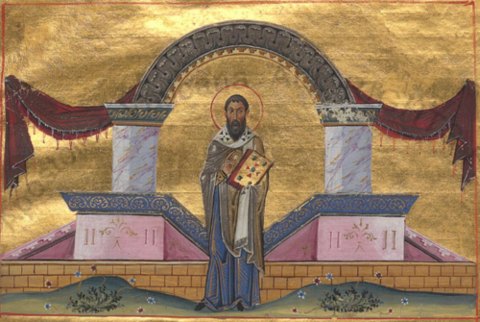
Sophronius (Ancient Greek: Σωφρόνιος; Arabic: صفرونيوس; c. 560 – 11 March 638), called Sophronius the Sophist, was the Greek Patriarch of the city known as Aelia Capitolina and then Jerusalem from 634 until his death. He is venerated as a saint in the Eastern Orthodox and Catholic Churches. Before rising to the primacy of the See, he was a monk and theologian who was the chief protagonist for orthodox teaching in the doctrinal controversy on the essential nature of Jesus and his volitional acts. He is also renowned for the negotiation of the surrender of Aelia Capitolina to the Rashid caliph Umar in 637/8.
Travels
Sophronius was born in Damascus around 560. He has been claimed to be of Byzantine Greek or Syriac descent. Sophronius became an ascetic in Roman Egypt about 580 and then entered the Monastery of Saint Theodosius near Bethlehem. A teacher of rhetoric, he travelled to monastic centres in Anatolia, Egypt, and Rome. He accompanied the Byzantine chronicler John Moschus, who dedicated to him his celebrated tract on the religious life, Spiritual Meadow (and whose feast day in the Byzantine Rite, 11 March [O.S. 24 March], is shared with Sophronius').
When Moschus died in Rome in 619, Sophronius accompanied the body to Aelia for a monastic burial. He traveled to Alexandria and Constantinople in 633 to try to persuade the respective patriarchs to renounce Monoenergism, a heterodox teaching that espoused a single, divine energy in Christ to the exclusion of a human capacity for choice. Except for his synodal letter for the Third Council of Constantinople, Sophronius' extensive writings on this question are all lost.