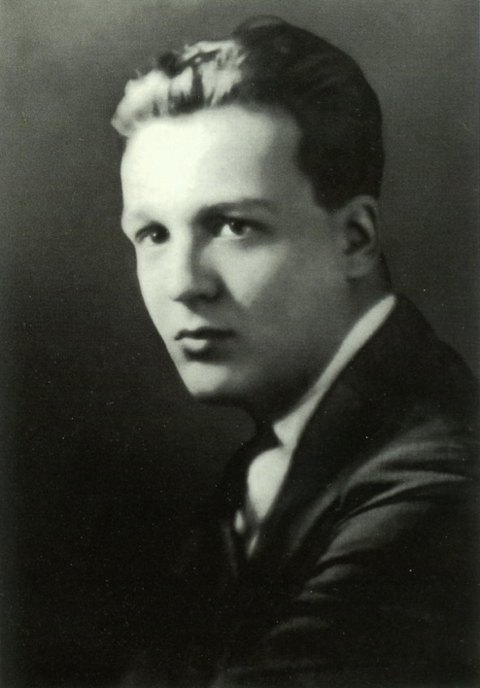
Stanley Grauman Weinbaum (April 4, 1902 – December 14, 1935) was an American science fiction writer. His first story, "A Martian Odyssey", was published to great acclaim in July 1934; the alien Tweel was arguably the first character to satisfy John W. Campbell's challenge: "Write me a creature who thinks as well as a man, or better than a man, but not like a man." Weinbaum wrote more short stories and a few novels, but died from lung cancer less than a year and a half later.
Life and career
Weinbaum was born in Louisville, Kentucky, the son of Stella (née Grauman) and Nathan A. Weinbaum. His family was Jewish.
He attended Riverside High School in Milwaukee. He was granted admission to the University of Wisconsin–Madison in Madison in July 1920. He first majored in chemical engineering, then switched to English, but contrary to common belief he did not graduate. On a bet, Weinbaum took an exam for a friend, and was later discovered; he left the university in 1923.
Weinbaum is best known for his groundbreaking science fiction short story "A Martian Odyssey", which presents a sympathetic but decidedly non-human alien, Tweel. This was his first science fiction story: in 1933 he had sold a romantic novel, The Lady Dances, to King Features Syndicate, which serialized the story in its newspapers in early 1934. Isaac Asimov described "A Martian Odyssey" as "a perfect Campbellian science fiction story, before John W. Campbell. Indeed, Tweel may be the first creature in science fiction to fulfil Campbell's dictum, 'write me a creature who thinks as well as a man, or better than a man, but not like a man'." Asimov went on to describe it as one of only three stories that changed the way all subsequent stories in the science fiction genre have been written. It was the oldest short story and one of the top vote-getters selected by the Science Fiction Writers of America for inclusion in The Science Fiction Hall of Fame, Volume One, 1929–1964.