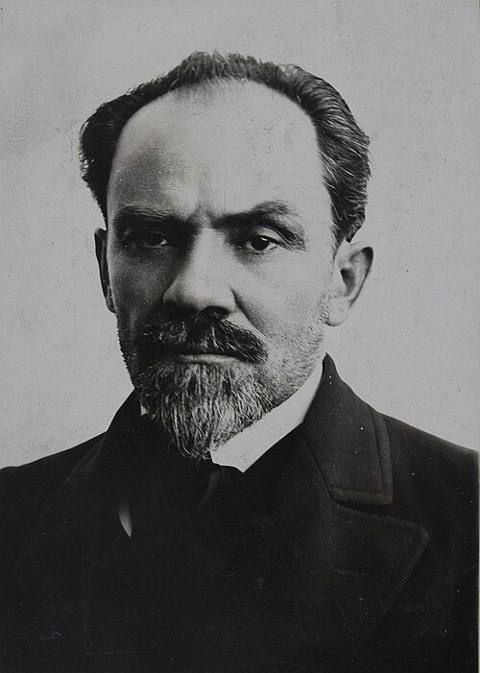
Stefan Żeromski ([ˈstɛfan ʐɛˈrɔmski]; 14 October 1864 – 20 November 1925) was a Polish novelist and dramatist belonging to the Young Poland movement at the turn of the 20th century. He was called the "conscience of Polish literature".
He also wrote under the pen names Maurycy Zych, Józef Katerla, and Stefan Iksmoreż.
He was nominated four times for the Nobel Prize in Literature.
Life
Stefan Żeromski was born on 14 October 1864 at Strawczyn, near Kielce.
Żeromski's parents died young, leaving him living in an impoverished state. He studied at the Kielce Municipal High School. He served as a tutor giving private lessons in 1888. In 1890, he obtained a job in Nałęczów, a spa town that attracted many intellectuals, artists and writers.
On 2 September 1892, he married a widow, Oktawia Rodkiewicz, née Radziwiłłowicz, whom he had met at a spa in Nałęczów, co-owned by her stepfather. One of the witnesses at the wedding was the novelist Bolesław Prus, an admirer of Oktawia's who had not been in favor of the marriage.
The newlyweds moved to Switzerland, where Żeromski worked from 1892 to 1896 as a librarian at the Polish National Museum in Rapperswil. At Oktawia's request Prus, though no admirer of Żeromski's writings, helped the struggling couple as much as he could.
In 1913 Żeromski started a new family with the painter Anna Zawadzka, whom he had met in 1908; they had a daughter, Monika.
In 1924, in recognition of Żeromski's achievements, President Stanisław Wojciechowski gave him a three-room apartment on the second floor of Warsaw's Royal Castle.